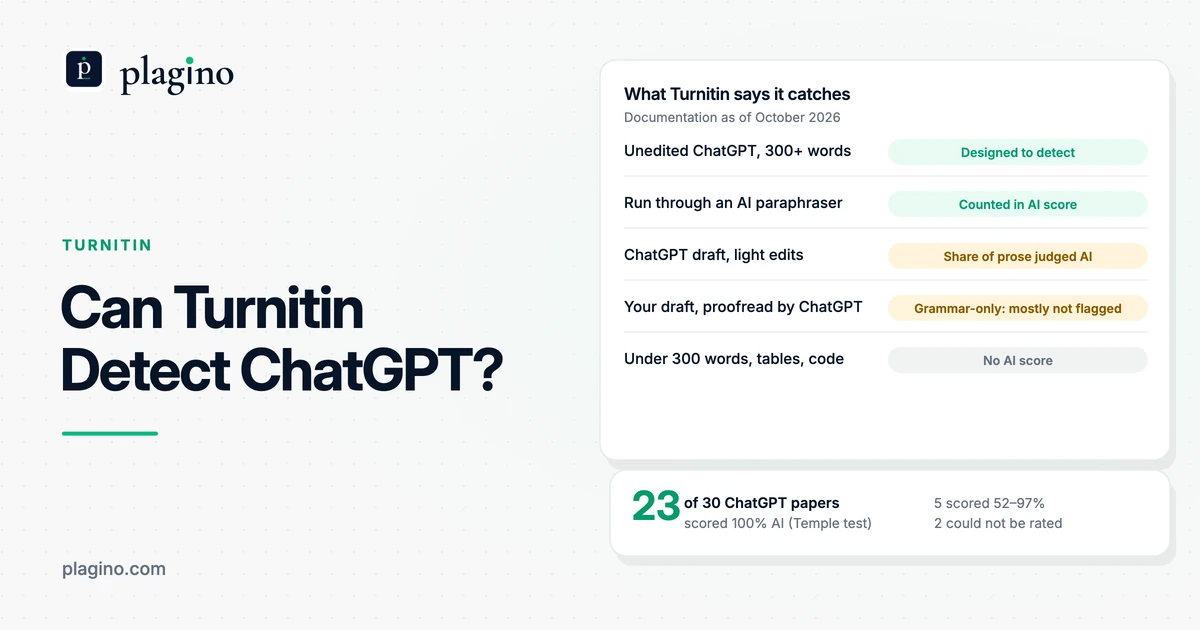
The short answer
Yes, where a school has switched on Turnitin's AI writing indicator. As of October 2026, Turnitin says its English model detects text from OpenAI's GPT-4o and GPT-5 models, plus tools built on them. It scores the prose you submit, not your chat history, and it is a signal for instructors, not proof.
Does Turnitin detect AI text from ChatGPT and other chatbots?
Yes, for the models it lists, in English, and only where the school has the feature on. Turnitin's AI writing FAQ says its English model can detect content from GPT-4o, GPT-4o-mini and the GPT-5 family up to GPT-5.4, along with listed Gemini, Claude, Llama, Mistral, DeepSeek, Nova and Grok models, and tools built on those models. The FAQ adds that Turnitin will continue to expand the list. That list is Turnitin's own claim, and a model that is not on it is not promised.
ChatGPT is a chat app, not one model, so Turnitin's list is by model. The report does not say "ChatGPT wrote this". Turnitin's report guide sorts flagged text into two kinds: likely AI-generated, and likely AI-generated then changed by a paraphraser or bypasser tool. Neither label names a tool. Some third-party guides still describe only GPT-3, GPT-3.5 and GPT-4 as targets, which is out of date against Turnitin's current list. Our guide to whether Turnitin detects AI covers who sees the score, the 20% asterisk rule and the file limits in full.
How does Turnitin detect ChatGPT writing?
It scores how predictable the writing is, using a trained model rather than a checklist. Turnitin's FAQ gives the idea in plain terms: language models such as ChatGPT tend to pick the next word in a consistent, highly probable way, while human writing is more inconsistent and idiosyncratic. The submission is cut into overlapping segments, each segment gets a score from 0 to 1, and the sentence scores are pooled into one document percentage.
Turnitin says the model is not programmed around single signals such as perplexity or burstiness. It learns patterns from its own training data, which the FAQ says covers AI-written and authentic academic writing across subjects and includes second-language writers. The same FAQ warns that individual predictions "may not always be explainable in simple feature-by-feature terms". The percentage only counts qualifying prose, and a file needs at least 300 words of it, under Turnitin's file requirements.
Can Turnitin detect ChatGPT text after you edit or paraphrase it?
Sometimes, and this is where the evidence is weakest. Turnitin says its English model also flags AI text changed by word spinners, AI paraphrasers and bypasser tools. Its release notes date that to December 2023 for word spinners, July 2024 for AI paraphrasing and August 2025 for bypassers. Independent testing of mixed human and ChatGPT text paints a less tidy picture.
In an early test, teaching and student success centers at Temple University submitted 120 samples to Turnitin: 30 human-written, 30 written by ChatGPT, 30 ChatGPT texts run through two free paraphrasing tools, and 30 mixed human and AI texts. The Temple report found Turnitin did best on human writing, scored 23 of 30 ChatGPT papers as 100% AI, and did worse on paraphrased and mixed text. For the mixed texts it found no relationship between the sentences flagged and the sentences ChatGPT actually wrote. The PDF is undated and tested an early version of the model, so treat it as direction, not a current rate.
A wider study points the same way. Weber-Wulff and colleagues tested 12 public detection tools plus Turnitin and PlagiarismCheck on ChatGPT-generated and human text. They concluded that the tools are neither accurate nor reliable, lean towards calling text human-written, and perform worse once the text has been obfuscated.
What happens with short ChatGPT passages?
Turnitin's FAQ says that in documents of only a few hundred words the prediction is mostly "all or nothing", because the model is scoring a single segment. A short piece that mixes your own writing with ChatGPT text could therefore be flagged as entirely AI-generated, or missed. Under 300 words of prose there is no AI score at all.
What happens to ChatGPT text in the most common situations?
The table below puts Turnitin's documentation next to what independent testing found, one situation at a time. Where nobody has published a test we could verify, it says Plagino has not tested it.
| Situation | What Turnitin's documentation says | What independent testing found |
|---|---|---|
| Unedited ChatGPT essay in English, 300+ words | Designed to be detected if the model is on Turnitin's list and the school has the feature on. | Temple's early test: 23 of 30 ChatGPT papers scored 100% AI, 5 scored between 52% and 97%, and 2 could not be rated. |
| ChatGPT text run through an AI paraphraser | Detected and counted in the AI score for English submissions. | Temple's early test, using two free tools: 19 of 30 scored 100% AI, 8 scored between 43% and 95%, and 3 could not be rated. Weber-Wulff found that obfuscation worsened detection. |
| ChatGPT draft with light human edits | No special rule. The score covers the share of qualifying prose the model judges to be AI. | Temple scored one lightly edited ChatGPT sample as 100% AI. Of its 30 mixed texts, 13 landed between 1% and 99%, and in the subset of reports it examined, flagged sentences did not match the AI-written ones. |
| Your own draft proofread by ChatGPT | The FAQ covers Grammarly: grammar-only edits were mostly not flagged, its generative features likely are. It gives no separate rule for ChatGPT rewrites. | Temple had one such sample, a human draft proofread by ChatGPT, and it scored 0% AI. One sample is an anecdote, not a rate. |
| Short passage under 300 words, or bullets, tables and code | No AI score under 300 words. Non-prose is not reliably detected. | Plagino has not tested this. |
| ChatGPT output in another language | Separate FAQs cover English, Spanish, Japanese, Arabic, Dutch, German and Turkish. Paraphraser and bypasser detection is English only. | Plagino has not tested this. |
| Ideas from ChatGPT, sentences written by you | The score is based on the prose in the submission. Turnitin does not decide whether a use of AI was allowed. | Plagino has not tested this. Your course policy decides whether the use was allowed. |
Does Turnitin detect copy and paste from ChatGPT?
Not as copy and paste. Turnitin's similarity score guide says the Similarity Report matches your text against web pages, previously submitted papers and publications. The AI indicator is a separate check on writing patterns, and Turnitin says the two scores do not influence each other. Whether fresh ChatGPT output matches any existing source depends on the text, and Plagino has not measured how often it does.
Paste tracking exists only in Turnitin Clarity, a paid add-on. Turnitin's Clarity AI guide says its pasted-text card appears when the model predicts that a pasted block of more than 300 words was likely written or altered by AI. That only applies to assignments an instructor has set up in Clarity. Our explainer on the Turnitin similarity score covers the matching side.
How accurate is Turnitin at flagging ChatGPT text?
Turnitin's stated target is a document-level false positive rate under 1% for documents with over 20% AI writing. It also says it accepts missing some AI text to keep that rate low: a document scored at 50% AI "could contain as much as 65% AI writing". At the sentence level it is less certain. In a May 2023 update, Turnitin put its sentence-level false positive rate at about 4%, and said 54% of falsely flagged sentences sat right next to genuinely AI-written text.
Turnitin also reports scale. In an October 2024 post it said that after reviewing 280 million student papers since April 2023, over 9.9 million were flagged as containing at least 80% AI writing. That is Turnitin's own count of flags, not an independent measure of how many papers ChatGPT wrote.
What does Plagino's benchmark show about ChatGPT-style text?
In Plagino's March 2026 benchmark of 1,000 documents, Turnitin caught 98.2% of the 500 AI-written documents and wrongly flagged 1.4% of the 500 human-written ones. Plagino caught 97.4% with 0.8% wrongly flagged. The AI half came from GPT-4o, Claude and Gemini, some lightly edited by a person, and we did not break results out by model, so these figures are not a ChatGPT-only rate.
Read them as results for one corpus, not as a promise for your essay. Plagino built one of the tools in the table, so check the method on the benchmark page before relying on the ranking.
Can ChatGPT or OpenAI tell if ChatGPT wrote a text?
OpenAI tried and stopped. Its January 2023 classifier correctly identified 26% of AI-written text as "likely AI-written" and wrongly labeled human text as AI-written 9% of the time on its test set. OpenAI withdrew it on July 20, 2023, citing its low rate of accuracy. Plagino has not tested whether chatbots can identify their own output, so do not treat a chatbot's answer as evidence.
| Detector | AI documents caught | 95% interval | Human documents wrongly flagged | 95% interval |
|---|---|---|---|---|
| Turnitin | 98.2% | 96.6–99.1% | 1.4% | 0.7–2.9% |
| Plagino (this site) | 97.4% | 95.6–98.5% | 0.8% | 0.3–2.0% |
| Originality.ai | 95.6% | 93.4–97.1% | 4.1% | 2.7–6.2% |
| Copyleaks | 91.3% | 88.5–93.5% | 2.2% | 1.2–3.9% |
| GPTZero | 88.9% | 85.8–91.4% | 5.7% | 4.0–8.1% |
| Academi.cx | 86.4% | 83.1–89.1% | 1.9% | 1.0–3.5% |
| TurnDetect | 79.5% | 75.7–82.8% | 6.3% | 4.5–8.8% |
What should you do if Turnitin flags ChatGPT use?
- 1
Read your course AI policy. Check the syllabus and assignment brief for what AI use is allowed. Policies differ by course, so a flag matters most when it conflicts with the rules you were given.
- 2
Ask to see the AI report. Students cannot see the AI indicator by default. Turnitin says only instructors and administrators can see it, so ask your instructor to share the report they are relying on.
- 3
Gather your process evidence. Collect outlines, notes, drafts, and version history from Word or Google Docs. If you used ChatGPT within the rules, keep the chat log and be ready to show how you used it.
- 4
Be accurate about any AI use. If you did use ChatGPT, say exactly how, and disclose or cite it the way your course requires. Do not guess or understate. A clear account is easier to assess than a vague one.
- 5
Ask for a human review. Turnitin says the AI percentage should not be the sole basis for adverse action against a student. Ask for the decision to rest on your drafts, your earlier work and a conversation, not on the number alone.
If the flag is wrong, our guide on what to do if you are falsely accused of using AI covers how to ask for the report and which evidence helps most. For the causes behind wrong flags, see why AI detectors produce false positives.
Does a clear Turnitin result mean ChatGPT use was allowed?
No. A low or zero AI score says the model did not flag the prose. It does not say whether your course allowed the help. Turnitin states that it does not determine misconduct, which rests with the instructor and the institution's policy. In its own myths post, Turnitin notes that some instructors want students to use generative AI for an outline, and others assign students to prompt ChatGPT and then edit the result. The rule is whatever your course says.
If you teach, our guide to using an AI detector as a teacher covers how to treat a score as one input among several. If you are a student who wants to see which sentences an automated detector might flag, you can run a draft through the Plagino AI detector. It will not reproduce your school's Turnitin score, and our guide to a Turnitin AI checker alternative explains what a pre-check can and cannot tell you.
Frequently asked questions
Can Turnitin detect ChatGPT if I only used it for ideas or an outline?
Turnitin scores the prose in your submission, not the tools you used to plan it. If the sentences are your own, there is nothing in the text for the model to attribute to ChatGPT, although false positives can still happen. Whether using ChatGPT for an outline is allowed is a question for your course policy.
Does Turnitin know which ChatGPT account wrote my text?
No. Turnitin's report guide describes a percentage and highlighted text that is likely AI-generated or AI-paraphrased. Nothing in it identifies a chatbot, an account or a chat history. Only Turnitin Clarity records writing activity, and only for assignments set up there.
Can Turnitin detect older ChatGPT versions like GPT-3.5?
Yes. Turnitin says its first detector targeted GPT-3 and GPT-3.5 and tools built on them, such as ChatGPT. It has since widened the English model to a long list of newer models. As of October 2026 that list includes GPT-4o and the GPT-5 family.
Does Turnitin detect Claude and Gemini the same way as ChatGPT?
Yes, for the versions on Turnitin's published list. As of October 2026 the list names several Claude and Gemini models alongside GPT models. A model that is not on the list is not promised.
Can Turnitin detect ChatGPT text that went through QuillBot?
Turnitin says it can, for English submissions. Its report guide names QuillBot as an example of an AI paraphrasing tool and counts text changed that way as AI-generated then paraphrased. The Temple test found weaker results on paraphrased text, so detection is not guaranteed.
What AI percentage does Turnitin show for ChatGPT text?
There is no fixed number. The indicator shows the share of qualifying prose the model judges to be AI. It shows 0%, an asterisk for detections between 1% and 19%, or a percentage from 20% to 100%. A fully ChatGPT-written paper may not score 100%.
Can Turnitin detect ChatGPT in a Word file or PDF?
Yes. Accepted file types are .docx, .pdf, .txt and .rtf, the file must be under 100 MB, and it needs at least 300 words of prose in a long-form format. Files outside those limits show a gray state with no percentage.
Can Turnitin check an old paper for ChatGPT use?
Yes, but only if the paper is resubmitted while AI writing detection is enabled for the account. Turnitin does not rescore past submissions on its own.
Does Turnitin detect ChatGPT text in languages other than English?
Partly. Turnitin says its AI writing detection covers long-form English, Spanish, Japanese, Modern Arabic, Dutch, German and Turkish. Paraphraser and bypasser detection is available only for English submissions.
Is Turnitin's ChatGPT detection 100% accurate?
No. Turnitin targets a document-level false positive rate under 1% and says it may miss some AI text to hold that rate. Independent tests found weaker results on edited and mixed text, so a score is a signal for review, not a verdict.
Can a teacher prove I used ChatGPT from a Turnitin score?
No. Turnitin says the AI percentage should not be the sole basis for adverse action against a student and that it does not determine misconduct. A fair review looks at drafts, earlier work and a conversation with the student.
Can I ask ChatGPT whether it wrote my text?
That is not reliable evidence. OpenAI withdrew its own AI text classifier in July 2023 because of its low accuracy. Plagino has not tested whether chatbots can identify their own output.
Will Plagino's AI detector give the same score as Turnitin for ChatGPT text?
No, and no outside tool can promise to. In Plagino's March 2026 benchmark the two were close on the benchmark corpus, with Turnitin catching 98.2% and Plagino 97.4%, but they are different models. Use Plagino as a pre-check on your own draft, not as a copy of your school's report.