The short answer
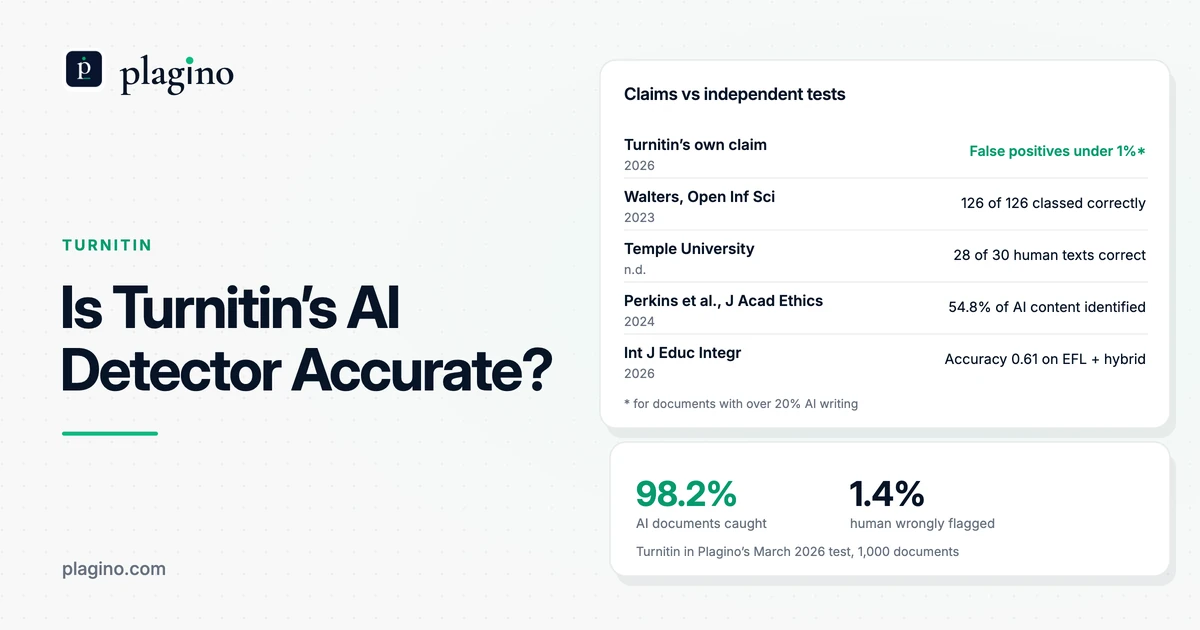
Mostly, on plain unedited AI text, and less so at the edges. Turnitin says it keeps false positives under 1% for documents with over 20% AI writing. Independent studies report weaker results on mixed human and AI writing. As of October 2026, treat the score as a prompt to review, not proof.
How accurate is the Turnitin AI detector by Turnitin's own numbers?
Turnitin's main claim is a low false positive rate. According to Turnitin's AI writing FAQ, it aims to keep the share of fully human-written documents wrongly flagged as AI under 1%, for documents with over 20% AI writing. In plain terms, about one in every 100 fully human-written papers could be wrongly flagged. Before each model update, the FAQ says, Turnitin tests on more than 700,000 academic papers written before ChatGPT existed.
The same FAQ admits a trade-off. To hold false positives down, Turnitin accepts that it will miss some AI text: a document it scores at 50% AI "could contain as much as 65% AI writing". The FAQ also says that in July 2026 Turnitin merged a multi-model ensemble into a single model and that the false positive rate stays under 1%. These are Turnitin's figures from its own tests, not independent results.
What does "under 1%" mean in a real classroom?
The 1% target is about whole documents, not single sentences. In a June 2023 update, Turnitin put its sentence-level false positive rate at around 4%, meaning a highlighted sentence has roughly a 4% chance of being human-written. It also found that 54% of those wrongly highlighted sentences sat right next to genuinely AI-written text, so errors tend to cluster at the edges of mixed documents.
Small rates still add up at scale. As simple arithmetic, a 1% rate means about 2 wrongly flagged papers for every 200 fully human-written ones. Vanderbilt University estimated that even a 1% rate on its roughly 75,000 annual submissions could mean about 750 papers wrongly labeled, one of the reasons it switched the AI indicator off in August 2023.
What do independent studies say about Turnitin AI detection accuracy?
Independent results are mixed, and most of the gap comes from what was tested. Early studies using unedited ChatGPT essays rated Turnitin highly. Later tests that added mixed human and AI writing, longer texts and science papers found much weaker results. Here is what each study did.
Walters (2023) tested 16 detectors on 126 documents: 42 ChatGPT-3.5 essays, 42 ChatGPT-4 essays and 42 first-year student essays written without AI. Turnitin and Copyleaks classified all 126 correctly. Walters cautions that Turnitin may have done especially well on the human papers in that particular set, and the study was accepted in September 2023, before most of Turnitin's later model updates.
Weber-Wulff and colleagues (2023) tested 12 public tools plus two commercial systems, Turnitin and PlagiarismCheck. They concluded that the tools are "neither accurate nor reliable", lean toward calling text human-written, and get worse when text is deliberately obscured. Their results are reported tool by tool, so read the paper itself for Turnitin's own row.
Perkins and colleagues had 22 GPT-4 submissions, written with prompts meant to reduce detection, marked by 15 staff alongside real student work. Turnitin flagged 91% of them as containing some AI, but identified only 54.8% of the content as AI. The study was posted in 2023, so it describes an early version of the detector.
The newest study is a 2026 paper in the International Journal for Educational Integrity. It compared Turnitin and Originality.ai on 192 texts, 48 in each of four groups: English-as-a-foreign-language (EFL) student writing, professional human writing, AI text from ChatGPT and Claude, and hybrid human-plus-AI text. Turnitin's overall accuracy was 0.61, against 0.69 for Originality.ai. It classed 93% of human texts as human, but only 29% of AI texts as AI and 31% of hybrid texts as hybrid. Results used the researchers' own cut-offs for Human, Hybrid and AI, and we have not confirmed which Turnitin model version was tested.
An earlier Temple University test sent 120 samples to Turnitin: 30 human, 30 ChatGPT, 30 ChatGPT texts run through free paraphrasing tools and 30 mixed texts. Turnitin scored 28 of the 30 human samples correctly and 23 of the 30 ChatGPT samples as 100% AI, and did worse on paraphrased and mixed text. The PDF is undated and tested an early version of the model.
| Source | Year | What was tested | What it found for Turnitin | Main limit |
|---|---|---|---|---|
| Turnitin AI writing FAQ | 2026 | Turnitin's own tests, including 700,000+ pre-ChatGPT papers | False positive rate under 1% for documents with over 20% AI writing; may miss some AI text | Vendor figures, not independently checked |
| Turnitin ELL evaluation | 2023 | Nearly 2,000 writing samples by English language learners | False positive rate 0.014 for ELL writers and 0.013 for native writers, on documents of 300+ words | Run by Turnitin, and the model has changed since |
| Walters, Open Information Science | 2023 | 126 documents: 42 ChatGPT-3.5, 42 ChatGPT-4, 42 student essays | Classified all 126 correctly | Small set; early model; author notes Turnitin may do especially well on these human papers |
| Weber-Wulff et al., Int J Educ Integr | 2023 | 12 public tools plus Turnitin and PlagiarismCheck | Tools as a group "neither accurate nor reliable", biased toward calling text human | Group-level conclusion in the abstract; early ChatGPT-era text |
| Perkins et al., J Academic Ethics | 2024 | 22 GPT-4 submissions made with prompts meant to reduce detection | Flagged 91% as containing some AI, but identified 54.8% of the content as AI | Small set; deliberately hard prompts; early model |
| Temple University teaching centers | Undated | 120 samples: 30 human, 30 ChatGPT, 30 paraphrased, 30 mixed | 28 of 30 human correct; 23 of 30 ChatGPT scored 100% AI; weaker on paraphrased and mixed | Undated PDF; early model |
| Int J Educ Integr (Springer) | 2026 | 192 texts: EFL student, professional human, AI and hybrid | Accuracy 0.61; 93% of human texts classed human, 29% of AI texts and 31% of hybrid texts classed correctly | Researchers' own cut-offs; model version not confirmed |
| Liang et al., Patterns | 2023 | 7 detectors on 91 TOEFL essays by non-native writers | Turnitin was not one of the detectors tested | Not a Turnitin result |
The studies disagree because they test different things. Unedited AI essays are the easy case. Mixed human and AI writing, lightly edited AI text, long papers and technical subjects are harder, and the 2026 study found both detectors weaker on exactly those. Turnitin has also updated its model several times since 2023 (our guide to how Turnitin's AI detector works lists the changes), so older studies describe older versions. Cut-offs matter too: a study that only counts a result as AI above a set percentage will score the same detector differently from one that uses a lower line.
We did not find an independent study that tests the current July 2026 model on a large, mixed corpus. Treat every figure above as a snapshot, and give more weight to studies whose texts look like yours.
How did Turnitin score in Plagino's AI detection benchmark?
In Plagino's March 2026 benchmark of 1,000 documents, Turnitin caught 98.2% of the 500 AI-written documents and wrongly flagged 1.4% of the 500 human-written ones. Its detection rate was the highest of the seven tools. The corpus was 500 AI-written (GPT-4o, Claude and Gemini, some lightly human-edited) and 500 human-written, scored at the document level with default settings.
Turnitin's measured false flag rate of 1.4% sits close to its own "under 1%" target, and with 500 human documents the 95% interval (0.7–2.9%) is wide. This benchmark and the 2026 journal study ask different questions. The benchmark has clean AI and clean human documents. The study adds hybrid text and EFL writing, which is harder, so both results can be true.
| Detector | AI documents caught | 95% interval | Human documents wrongly flagged | 95% interval |
|---|---|---|---|---|
| Turnitin | 98.2% | 96.6–99.1% | 1.4% | 0.7–2.9% |
| Plagino (this site) | 97.4% | 95.6–98.5% | 0.8% | 0.3–2.0% |
| Originality.ai | 95.6% | 93.4–97.1% | 4.1% | 2.7–6.2% |
| Copyleaks | 91.3% | 88.5–93.5% | 2.2% | 1.2–3.9% |
| GPTZero | 88.9% | 85.8–91.4% | 5.7% | 4.0–8.1% |
| Academi.cx | 86.4% | 83.1–89.1% | 1.9% | 1.0–3.5% |
| TurnDetect | 79.5% | 75.7–82.8% | 6.3% | 4.5–8.8% |
Two limits matter. The AI half of the corpus came from GPT-4o, Claude and Gemini, some lightly edited by a person, so it is not a test of heavily rewritten or hybrid papers. And it is a single March 2026 run, so it does not show how Turnitin handles every model released since.
How often does Turnitin flag human writing as AI?
Rarely on whole documents, but not never. Turnitin targets under 1%, and Plagino's run measured 1.4% on 500 human documents. In the 2026 journal study, Turnitin classed 93% of the 96 human-written texts as human, so about 7% were not. Some of those may have been labeled hybrid rather than AI, because that study used three categories.
Turnitin names the conditions that raise the risk. Its report guide says its testing found a higher incidence of false positives when the score is between 0% and 19%, which is why the indicator shows an asterisk instead of a number in that range. The FAQ adds that false positives can involve content without much structural variation, text that literally repeats itself, or text paraphrased without new ideas. On very short documents the prediction is "all or nothing", because the model scores a single segment.
Length is part of the fix. Turnitin says its testing showed a slightly higher-than-comfortable false positive rate on submissions under 300 words, so it set a 300-word minimum for an AI score. Our guide to why AI detectors produce false positives explains the wider causes.
Is Turnitin's AI detector biased against non-native English writers?
The evidence is mixed and limited. A Stanford-led study by Liang and colleagues found that seven AI detectors wrongly flagged an average of about 61% of 91 TOEFL essays by non-native English writers. Turnitin was not one of those detectors, and Turnitin points out that the essays were all under 150 words.
Turnitin's own evaluation of nearly 2,000 samples by English language learners found a false positive rate of 0.014 for those writers and 0.013 for native English writers on documents of 300 words or more, a difference it calls not statistically significant. For documents under 300 words it found a larger gap. In the 2026 journal study, Turnitin was correct on 44 of 48 EFL texts and 45 of 48 professional texts, a small difference that the authors did not find significant. The two Turnitin-related results are small samples, and one is Turnitin's own.
What does Turnitin's AI detector miss?
It misses some AI text on purpose. Turnitin says it tolerates missed AI writing so that it does not wrongly highlight human work, which is why a 50% result could hide as much as 65% AI writing. The 2026 journal study shows the same pattern on mixed text: Turnitin recognized only 31% of hybrid texts, and the Perkins study found that Turnitin identified only 54.8% of the content as AI-generated, even though it flagged 91% of the submissions.
Some limits are built in. Turnitin's FAQ says the model does not reliably detect AI-generated text in non-prose or code, or in short-form writing such as bullet points, and that AI paraphraser and bypasser detection works for English only. The report guide says its Spanish and Japanese detectors do not include paraphraser or bypasser detection. A paper under 300 words gets no AI score at all.
None of this means the detector is useless. It means a low or zero score is not proof that no AI was used, just as a high score is not proof that it was.
Is Turnitin more accurate than other AI detectors?
It depends on the test, so no single ranking holds. In Plagino's benchmark, Turnitin had the highest detection rate (98.2%), ahead of Plagino (97.4%), Originality.ai (95.6%), Copyleaks (91.3%) and GPTZero (88.9%). On false flags, Plagino was lower at 0.8% against Turnitin's 1.4%, while Originality.ai (4.1%) and GPTZero (5.7%) flagged more human documents.
Other studies reorder the field. In the 2026 journal study, Originality.ai beat Turnitin overall (0.69 against 0.61) but caught almost none of the hybrid texts (a recall of 0.02). In Walters's 2023 test, Turnitin and Copyleaks were correct on all 126 documents and Originality.ai on all but two. Plagino has not benchmarked other tools, such as ZeroGPT or Pangram, so we make no accuracy claim for them. Our guide to the best AI detectors compares the options, and our page on alternatives to Turnitin covers what each one checks.
Is Turnitin accurate for plagiarism checking too?
The AI score and the similarity score are separate checks. Turnitin's guide to the similarity score explains that the similarity score is the share of a paper that matches Turnitin's sources, and that quoted and referenced text also counts as a match. Its own example compares a student who pasted in text (20%) with a student who quoted and cited several sources correctly (22%). The number is a prompt to review the matches, not a verdict.
Plagino's benchmark covers AI detection only, so we have no accuracy figures for Turnitin's text matching. Our explainer on the Turnitin similarity score shows how to read it.
How should you read a Turnitin AI score?
Treat the score as the start of a conversation. These six checks follow Turnitin's own guidance and the limits above.
- 1
Check the indicator state. An asterisk (*%) means AI was detected above 0% but below 20%. Turnitin calls that range less reliable and shows no percentage or highlights. A gray indicator means the file was not processed.
- 2
Check the length and the writing type. A paper of only a few hundred words gets an all-or-nothing prediction. Tables, lists, code and bibliographies are left out of the percentage, so the number and the highlights may not line up.
- 3
Read the highlights, not just the headline number. Errors cluster where human and AI text meet. Turnitin found that 54% of wrongly highlighted sentences sat next to genuinely AI-written text.
- 4
Ask whether the paper is mixed. Mixed human and AI writing is the hardest case for every detector. A 50% score could mean as much as 65% AI writing, and a lightly assisted paper can score very differently from a fully generated one.
- 5
Look for process evidence. Outlines, notes, dated drafts and version history show how the work developed. That record is stronger evidence than any single detector score.
- 6
Decide under the institution's policy. Turnitin says the percentage should not be the sole basis for adverse action against a student. The decision belongs to people applying the academic integrity policy.
Teachers can find a fuller workflow in our guide to using an AI detector as a teacher. Students who have been flagged can read our guide on what to do if you are falsely accused of using AI. To see which sentences a detector may flag before you submit, you can run your own draft through the Plagino AI detector. It will not reproduce your school's Turnitin score, because the two are different models.
Frequently asked questions
Is the Turnitin AI detector accurate?
Mostly on plain, unedited AI text, and less so on mixed writing. Turnitin says its false positive rate is under 1% for documents with over 20% AI writing. Independent studies report weaker results for hybrid texts, so use the score as a signal, not proof.
How accurate was Turnitin in Plagino's benchmark?
In Plagino's March 2026 benchmark of 1,000 documents, Turnitin caught 98.2% of AI-written documents and wrongly flagged 1.4% of human-written ones. It is one corpus and one run, and Plagino makes a competing detector, so read the method on the benchmark page.
What is Turnitin's false positive rate?
Turnitin's stated target is under 1% for documents with over 20% AI writing. At the sentence level it reported about 4% in June 2023. Both are Turnitin's own figures, not independent results.
Can Turnitin's AI detector be wrong?
Yes. Turnitin's report guide says the model may not always be accurate and may misidentify human-written, AI-generated and AI-paraphrased text. It adds that the score should not be the sole basis for adverse action against a student.
Is a 100% AI score on Turnitin always right?
No. A high score is a strong signal, but it is not proof. On short documents the prediction is mostly all or nothing, so a paper that mixes human and AI writing can be flagged as entirely AI.
Why does Turnitin show an asterisk instead of an AI percentage?
It means AI was detected above 0% but below 20%. Turnitin hides the number and the highlights in that range because its testing found false positives are more common at low percentages.
Does Turnitin AI detection work on short texts?
Not below 300 words. A submission needs at least 300 words of prose in a long-form format to get an AI score. Turnitin raised the minimum because shorter submissions had a higher false positive rate in its tests.
Is Turnitin biased against non-native English speakers?
Turnitin says its own test found no statistically significant bias on documents of 300 words or more. The widely cited Stanford study did not include Turnitin. The evidence for Turnitin specifically is limited, and the main test was run by Turnitin.
Is Turnitin more accurate than GPTZero or Originality.ai?
It depends on the test. In Plagino's benchmark Turnitin caught 98.2% of AI documents against 95.6% for Originality.ai and 88.9% for GPTZero, with fewer false flags than both. In a 2026 journal study Originality.ai scored higher overall.
Can Turnitin detect AI text that has been edited?
Partly. Turnitin says its English model also detects AI text run through paraphrasers. Independent tests found mixed texts are the hardest case: one 2026 study found Turnitin recognized 31% of hybrid texts, so edited or mixed work can be missed.
Does Grammarly cause Turnitin AI flags?
Usually not for spelling, grammar and punctuation fixes. Turnitin says its tests found those edits were not flagged in most cases. Text produced by Grammarly's generative features, such as drafting or paraphrasing, will likely be flagged.
Is Turnitin accurate for plagiarism checking?
Turnitin's similarity score shows how much of a paper matches its sources. It does not decide whether plagiarism happened, since quoted and cited text also matches. Plagino's benchmark covers AI detection only, so we have no accuracy figure for text matching.
What should I do if Turnitin flags my own writing?
Ask your instructor to show you the report and explain the flagged passages. Share drafts, notes and version history that show how you wrote the work. Turnitin itself says the score should not be the only basis for action.
Can I check my paper's Turnitin AI score myself?
Not by default. Turnitin says only instructors and administrators can see the AI indicator, and an instructor can choose to share the report. An outside tool such as the Plagino AI detector can pre-check a draft, but its score will not match your school's Turnitin result.