The short answer
A college AI detector for students scans a draft before you submit it. Your college's own detector is usually instructor-only, so no outside tool can show you that exact score. Plagino marks the sentences that read as AI-written and matches open academic sources. Treat the result as a reason to reread, not as proof.
What is a college AI detector, and which one will your college use?
A college AI detector is software that estimates how much of a paper reads like it was written by a language model such as ChatGPT. Colleges buy it, switch it on and decide who sees the results. That is why there is no single tool that applies to every student. Which one your instructor uses depends on your college, your department and sometimes the course.
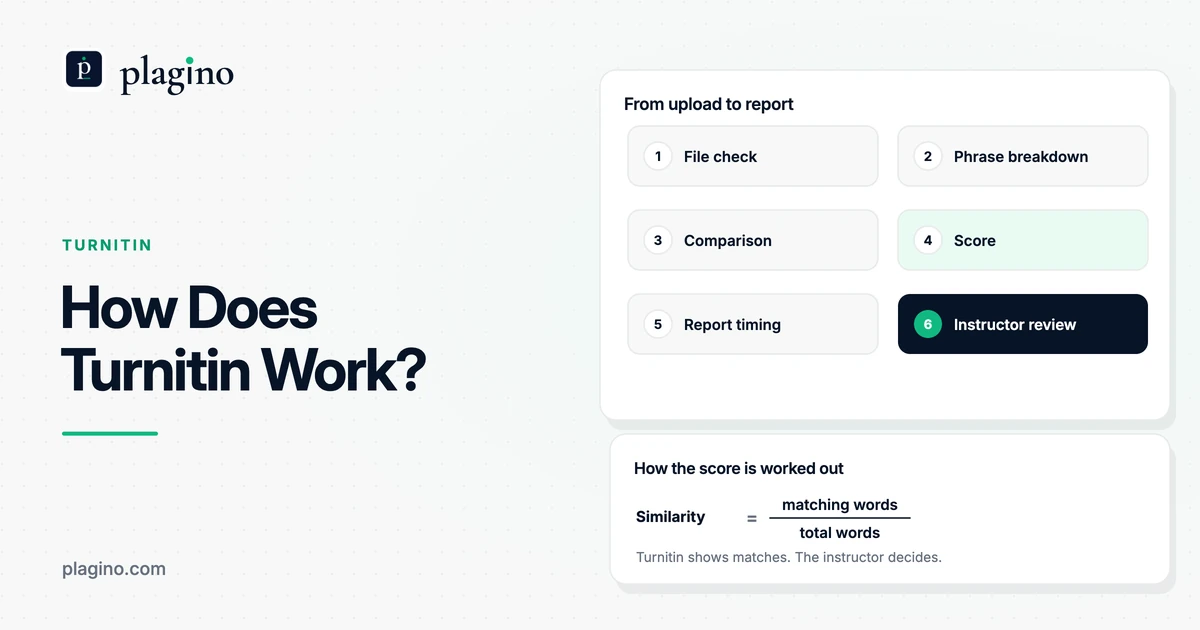
The best known is Turnitin's AI writing indicator. Turnitin's own FAQ says it is a separate feature of the Similarity Report, available only to customers that license Turnitin Originality, and that administrators can switch it off. It also says the indicator and report are not visible to students, although instructors can download the report as a PDF and share it. Other colleges use other tools, or none. Our guide on whether Turnitin detects AI covers what the indicator measures.
Turnitin adds that it does not make a determination of misconduct and that the percentage should not be the sole basis for action. A flag is meant to start a conversation with an instructor, not to end one.
Can you check your paper with your college's AI detector first?
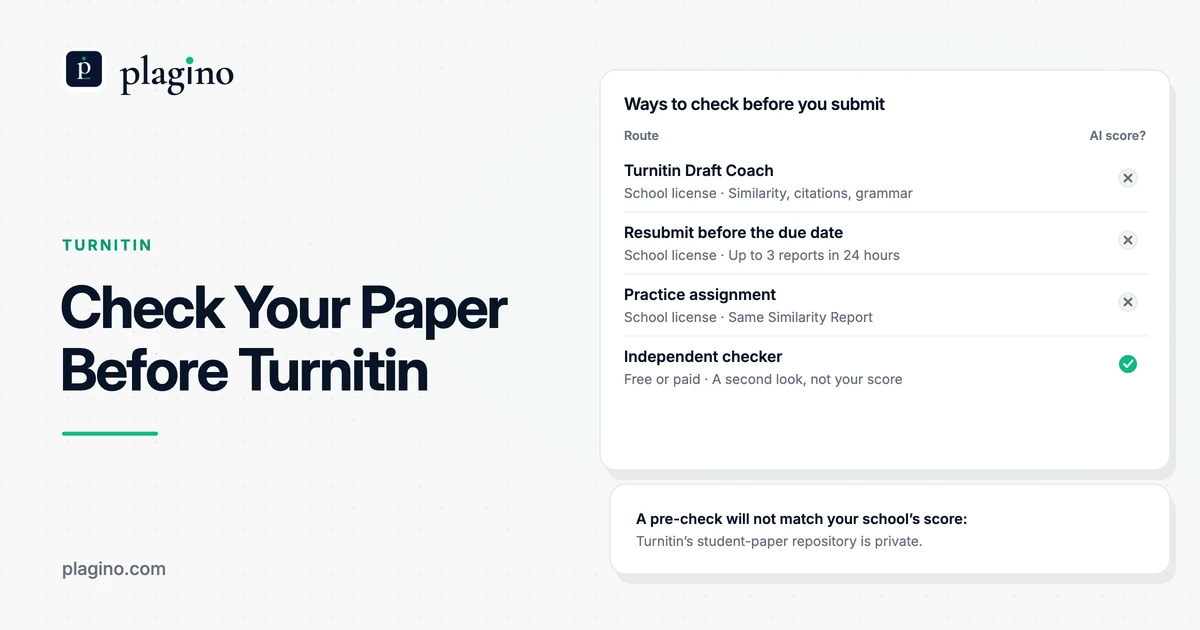
Usually not with the same tool. Because the instructor-side report is hidden from students, no outside website can show you your college's score. You can still use other routes that show you different things. The table compares them as of October 2026.
| Route | What it shows you | Shows an AI score? | Main catch |
|---|---|---|---|
| Your college's own detector | The instructor-side AI indicator and highlighted report | Yes, but only instructors see it | Turnitin says students cannot see it; an instructor can download and share the PDF |
| Turnitin Draft Coach | Similarity, citation and grammar checks inside Google Docs or Word online | No | Your college has to set it up; it is license dependent |
| Ask your instructor | A practice assignment or a shared report, if the course allows it | Only if they choose to share it | Depends on the instructor and the course policy |
| Free student-facing AI checkers (for example Scribbr, Paperpal, Proofademic) | A score and highlights from each vendor's own model | Yes, from the vendor's model | Not your college's tool; free limits are set by each vendor; Plagino has not benchmarked them |
| Plagino | Sentence-level AI highlights, matches to open academic sources and a PDF report | Yes, from Plagino's model | Not your college's tool; the plagiarism check covers open-access sources only |
Draft Coach is the closest thing to an official pre-check, but it is not an AI check. Turnitin's Draft Coach FAQ says it works as an add-on in Google Docs or Word online, must be configured by your institution's administrator and is license dependent. The University of Missouri System's help page says its Similarity Check does not detect possible use of AI in writing.
Free checkers differ on limits. According to its own comparison table, Paperpal's free tier allows 5 scans a day of up to 1,200 words each. Scribbr offers a free AI detector, and Proofademic lists a one-time free allowance of 1,000 words. These are the vendors' own statements, and Plagino did not test any of them. Different detectors disagree on the same text, so a clean result from one is not a promise about another.
How does Plagino work as a college AI detector?
Plagino is our tool, so read this section with that in mind. You upload a .docx file of up to 10 MB and get back a PDF report with two separate signals: sentence-level highlights where the writing reads as AI-generated, and passages that match open-access academic papers. The report is meant for review. You read the highlighted sentences and decide what, if anything, to change. The AI detector page shows how it works and links a sample report.
The Free plan gives 3 scans a month with no card. Pro is $19 a month for 20 scans a day, with a priority queue and email support. Plans are on the pricing page. Your files stay in your account so you can reopen a report, and you can delete any scan from your dashboard. The privacy policy says uploaded documents are not used to train AI models. Read it before you upload coursework.
Plagino is not your college's detector, and its score will not match your college's tool. What it gives you is a way to see which sentences read as machine-like to one detector, so you can reread them before someone else does.
How accurate are college AI detectors?
The only head-to-head data Plagino can stand behind is its own benchmark. The corpus had 1,000 documents: 500 AI-written (GPT-4o, Claude and Gemini, some lightly human-edited) and 500 human-written. Every tool saw the same files through its own web app on default settings, in March 2026. Scores are document-level: a document counts as flagged if the tool flags it at all.
| Detector | AI documents caught | 95% interval | Human documents wrongly flagged | 95% interval |
|---|---|---|---|---|
| Turnitin | 98.2% | 96.6–99.1% | 1.4% | 0.7–2.9% |
| Plagino | 97.4% | 95.6–98.5% | 0.8% | 0.3–2.0% |
| Originality.ai | 95.6% | 93.4–97.1% | 4.1% | 2.7–6.2% |
| Copyleaks | 91.3% | 88.5–93.5% | 2.2% | 1.2–3.9% |
| GPTZero | 88.9% | 85.8–91.4% | 5.7% | 4.0–8.1% |
| Academi.cx | 86.4% | 83.1–89.1% | 1.9% | 1.0–3.5% |
| TurnDetect | 79.5% | 75.7–82.8% | 6.3% | 4.5–8.8% |
In this run Turnitin caught the most AI writing (98.2%) and Plagino wrongly flagged the fewest human documents (0.8%). The confidence intervals for those two false-positive rates overlap, so the gap is indicative, not decisive. Turnitin's own claim is different and measured differently: its FAQ says it aims to keep the false-positive rate under 1% for documents with more than 20% AI writing. That is a vendor claim, and Plagino did not test it separately.
Every detector has a false-positive rate above zero. Our explainer on why AI detectors produce false positives covers what trips them.
What are the odds an honest student gets flagged?
A small rate sounds harmless until it is applied to many papers. The table takes each detector's false-positive rate from the benchmark and works out the chance that at least one of a student's honest papers is flagged. It assumes every paper carries the same independent chance. That is an illustration of the arithmetic, not a prediction, because real flags cluster around particular writing styles. A flag is also not an accusation: it is a prompt for review.
| Detector | Honest documents wrongly flagged (benchmark) | At least 1 of 10 honest papers flagged | At least 1 of 40 honest papers flagged |
|---|---|---|---|
| Turnitin | 1.4% | 13.2% | 43.1% |
| Plagino | 0.8% | 7.7% | 27.5% |
| Originality.ai | 4.1% | 34.2% | 81.3% |
| Copyleaks | 2.2% | 19.9% | 58.9% |
| GPTZero | 5.7% | 44.4% | 90.4% |
| Academi.cx | 1.9% | 17.5% | 53.6% |
| TurnDetect | 6.3% | 47.8% | 92.6% |
The average hides who carries the risk. In a 2023 study in Patterns, Liang and colleagues ran 91 TOEFL essays by non-native English writers through seven detectors, and on average the detectors misclassified 61.22% of them as AI-generated. If English is your second language, take the sentence-level highlights seriously, keep your drafts, and read our guide for students who are falsely accused of using AI before you need it.
What does a college AI detector actually read in your paper?
Detectors do not all score the same parts of a file. The table lists what Turnitin says about its own AI writing detection for English submissions, using its FAQ as read in October 2026. Other tools set their own rules.
| Topic | What Turnitin says |
|---|---|
| What is scored | Prose sentences in long-form writing. Lists, headers, references, data tables, formulas and code are left out |
| Short documents | Under 300 words of qualifying prose, the document is not processed |
| The percentage | The share of evaluated sentences classed as AI, not necessarily the share of the whole file |
| Low scores | Scores from 1% to 19% are not shown; the report shows an asterisk instead |
| Grammar checkers | In its tests on human-written documents, changes from grammar tools such as Grammarly were mostly not flagged; content from generative features such as draft generation, paraphrasing and summarizing will likely be flagged |
| Reworded AI text | The detector also looks for AI-generated text that was modified by paraphrasing tools |
In practice, the score describes the prose in your paper, not your reference list or tables. Plain grammar fixes are a different thing from text that an AI tool wrote for you. If you use an AI-powered feature, check your course rules first, because some courses ban even grammar tools. Our Plagino vs Grammarly comparison covers how Grammarly's detector and checker differ.
How to check your draft before you submit it
This routine works with any detector, including Plagino. It is built around keeping your own voice and your own evidence, not around the score.
- 1
Read the course AI policy. Find the syllabus or assignment rules on AI. Some courses allow brainstorming or grammar help, some allow nothing, and some ask you to disclose what you used. Write down what applies to this paper.
- 2
Write in a tool with version history. Draft in Google Docs or Word with version history on, so you can show how the paper grew if anyone asks. Keep outlines and notes too.
- 3
Run a check on the finished draft. Upload the .docx to Plagino or another checker. Use the highlighted sentences, not only the overall percentage.
- 4
Read each flagged sentence. Ask whether it says something specific that you meant, in words you would use. If it is vague filler you could not defend in a seminar, replace it with your own reasoning and evidence. A flag is not an instruction to reword the sentence.
- 5
Check sources and citations. Make sure every quote and claim is cited, and every source you cite exists and says what you say it does. Passages that match open academic papers should be quotes or cited.
- 6
Keep the evidence. Save drafts, notes and the report PDF in one folder. If a detector at your college flags the paper, you can show your process instead of arguing about a score.
If a college detector flags you anyway, our guide on being falsely accused of using AI walks through the steps. For the matching side of a pre-check, see the plagiarism checker page and our Turnitin similarity score explainer.
Is there an AI detector for college essays and applications?
Admissions essays are a separate case from coursework. Notre Dame's admissions AI policy adopts the Common App fraud policy, which it quotes as prohibiting intentionally misrepresenting as one's own work "the substantive content or output of an artificial intelligence platform, technology, or algorithm". The same page says applicants may use AI for spelling and grammar review or brainstorming, but that the content of all essays must be their own work. The primary source is the Common App fraud policy.
Whether a given admissions office runs a detector is less clear. In 2023 reporting by CalMatters, a University of Southern California spokesperson said the university was not employing AI-detection software, and the University of San Francisco said it would not use detection software for applications. That reporting is three years old, and Plagino has no current, sourced list of admissions offices that use detectors. Ask the college, and read its AI policy page.
Plagino works on a .docx draft of any length up to its file limit, including an application essay. It cannot tell you what an admissions office will do.
What are Plagino's limits for college students?
We would rather you knew these before you sign up.
It is not your college's tool
Plagino cannot see Turnitin's private repository, and its plagiarism check does not search the open web, paywalled journals or other students' papers. It matches against open-access academic literature indexed by CORE. A clean Plagino result does not mean your college's similarity report will be clean. See the best plagiarism checkers for students comparison for the trade-offs, and our guide to Turnitin alternatives for what students can and cannot run.
Word files only, and no LMS link
Plagino takes .docx files up to 10 MB, one at a time, through its web app. It does not connect to learning platforms such as Canvas or Moodle, so you upload the file yourself. Our page on Canvas and AI detection explains how a college's platform fits in.
Its benchmark is its own
Our accuracy figures come from one benchmark that we designed and ran, on English essays, on default settings, in March 2026. An independent replication would carry more weight. A 0.8% false-positive rate still means some honest writing is flagged. Instructors who want the other side of this page can read our guide on the best AI detector for teachers.
Frequently asked questions
What is the best college AI detector for students?
There is no single best one, because it depends on whether you want a pre-check or an official result. In Plagino's March 2026 benchmark, Turnitin caught the most AI writing (98.2%) and Plagino wrongly flagged the fewest human documents (0.8%). Plagino has not benchmarked tools such as Scribbr, Paperpal or Proofademic.
Which AI detector do colleges use?
Colleges choose their own, and there is no public master list. Turnitin's AI writing indicator is the best known and is sold with Turnitin Originality, and administrators can switch it off. Some colleges use other tools or none, so check your syllabus or ask your instructor.
Can I check my paper with my college's AI detector?
Usually not. Turnitin says its AI indicator and report are not visible to students, although instructors can download and share the report. Draft Coach, where a college offers it, checks similarity, citations and grammar but not AI use.
Will a free AI detector give the same result as my college's?
No. Each detector uses its own model and thresholds, so the same paper can score differently in two tools. Plagino's scores do not match any institution's tool either. Use a pre-check to find sentences worth rereading, not to predict an outcome.
Is Plagino free for students?
Yes, there is a Free plan with 3 scans a month and no card needed. Pro costs $19 a month for 20 scans a day, with a priority queue and email support. Team pricing for departments and writing centres is custom.
What files can I upload to Plagino?
Word documents (.docx) up to 10 MB, one at a time. Plagino does not connect to learning platforms such as Canvas or Moodle, so you upload the file yourself.
Can an AI detector flag my own writing?
Yes. Every AI detector produces false positives. In Plagino's March 2026 benchmark the rate for honest documents ran from 0.8% to 6.3% depending on the tool. Formulaic prose and second-language writing carry extra risk.
What should I do if my college flags my paper as AI-written?
Reply calmly and in writing, and gather your drafts, notes and version history. Turnitin itself says the percentage should not be the sole basis for action. Our guide on being falsely accused of using AI sets out the steps.
Does Turnitin flag Grammarly?
Turnitin says changes from grammar tools such as Grammarly were mostly not flagged in its tests on human-written documents. It also says content from generative features, such as draft generation, paraphrasing and summarizing, will likely be flagged. Check your course rules, because some courses restrict grammar tools too.
Does a college AI detector check my references and bullet lists?
Turnitin says it scores prose sentences in long-form writing and leaves out lists, headers, references, data tables, formulas and code. Other detectors may work differently. Turnitin also does not process documents with under 300 words of qualifying prose.
Do colleges run AI detectors on admissions essays?
Practice varies, and Plagino has no current sourced list. The Common App fraud policy covers the substantive content or output of an AI platform, and individual colleges publish their own AI rules. Read the admissions page of each college you apply to.
Is it safe to upload my paper to an AI detector?
Check what the tool does with your file before you upload. Plagino's privacy policy says uploaded documents are not used to train AI models, and that deleting a scan removes its stored file and report. Read the policy of any checker you use, and confirm that your course allows outside tools.
Does Plagino keep my paper?
Files stay in your account while it is active so you can reopen reports, and you can delete any scan from your dashboard. To find plagiarism matches, only short extracts needed for matching are sent to CORE, an open-access research index. The privacy policy has the full detail.