The short answer
A Turnitin score is usually two separate numbers. The similarity score shows how much of your text matches Turnitin's database. The AI writing score, if your school licenses it, shows how much of your qualifying prose looks AI-generated. Neither is a verdict. Your instructor reads both, plus the highlights.
What is a Turnitin score?
"Turnitin score" can mean two different percentages, and they answer two different questions. The similarity score asks "does this text match something already written?" The AI writing score asks "does this prose read like a language model wrote it?" Turnitin calculates them independently, so one never feeds into the other.
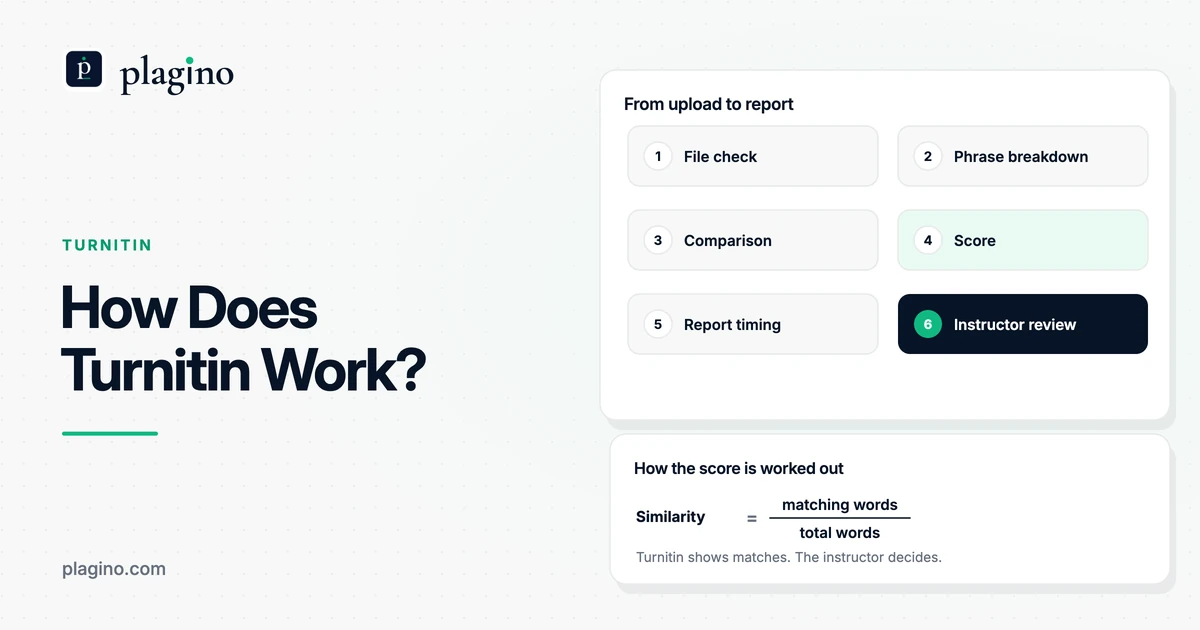
Every submission that goes through Turnitin's Similarity Report gets a similarity score. The AI writing indicator only appears when your institution has licensed and switched on Turnitin's AI detection. So two students at different schools can submit the same essay and see a different number of scores. If you are not sure how a paper gets from your learning management system (LMS) to the report, our guide on how Turnitin works walks through each stage.
Where does each number appear in the Turnitin report?
The similarity score is the percentage most students see. It sits next to the submission in the assignment inbox inside Canvas, Moodle, Blackboard or Brightspace, often in a colored box. The AI score does not. Turnitin says no AI score is shown in the LMS interface. Instructors open the Similarity Report and select the AI Writing tab to see it.
Visibility differs too. Turnitin's FAQ states that only instructors and administrators can see the AI writing indicator and its report, which are "not visible to students". An instructor can download the AI report as a PDF and share it. If your instructor raises a concern, you can ask to see the report they are relying on.
What does each Turnitin percentage mean?
Both numbers are percentages of your paper, but not of the same thing. The similarity score divides matching words by the total words in the document. The AI score divides AI-flagged sentences by qualifying prose only, which leaves out lists, tables, code and the reference list. That is why the two numbers rarely line up.
| Similarity score | AI writing score | |
|---|---|---|
| Question it answers | How much of the text matches sources in Turnitin's database? | How much of the qualifying prose does Turnitin's model predict was AI-generated or AI-paraphrased? |
| What it counts | Matching words ÷ total words in the document | Flagged prose sentences ÷ all qualifying prose (long-form sentences only) |
| What is left out | Only what the instructor's filters exclude, such as quotes, bibliography or small matches | Lists, headers, tables, code and references are never part of the calculation |
| What you can see | 0% to 100%, usually with a colored band | 0%, an asterisk (*%) for 1% to 19%, or 20% to 100% with highlights |
| Who sees it | Instructors, and students if the assignment settings allow | Instructors and administrators only, unless the instructor shares it |
| Turnitin's own caveat | Not a plagiarism score. No single acceptable or perfect percentage | Not proof of misconduct. Should not be the sole basis for adverse action |
The similarity side has its own deep guides. For what the percentage counts and what an acceptable range looks like, see Turnitin similarity score explained. For the blue, green, yellow, orange and red boxes, see what green on Turnitin means. The rest of this page focuses on the AI number and on reading the two together.
What is a good AI score on Turnitin?
There is no official "good" AI score. Turnitin publishes no pass mark. What it does publish is a reliability line at 20%. Below that, its testing found more false positives, so since July 2024 the indicator shows an asterisk with no number and no highlights. A 0% means no qualifying prose was flagged.
That 20% line is the closest thing to a built-in threshold. Turnitin's stated target is a document-level false positive rate under 1% for papers with more than 20% AI writing, meaning about one wrongly flagged paper per 100 fully human ones. At the sentence level it reported about 4% in June 2023. Schools and journals that need a working rule set their own on top of that, and they do not agree.
What is a high Turnitin score?
A high Turnitin score means different things on each axis. A high similarity score means a lot of the text matches existing sources, which may just be quotes and a long reference list. A high AI score means the model flagged a large share of the prose. In both cases, a high number is a reason to read the highlights.
On the AI side, high does not mean exact. Turnitin's FAQ says it accepts missing some AI text to keep false positives low, so a paper scored at 50% "could contain as much as 65% AI writing". Short papers add another caveat. Under a few hundred words the prediction is close to all-or-nothing, so one paragraph of mixed writing can push the whole score up. Accuracy at the edges is covered in is the Turnitin AI detector accurate?
| Who | Similarity guidance | AI score guidance | Status |
|---|---|---|---|
| Turnitin | No single acceptable or perfect score | Scores under 20% shown only as *%; not a sole basis for action | Vendor guidance |
| National College of Ireland library FAQ (2022) | 15% to 20% is "a good score to aim for" | Not covered | University FAQ |
| University of Suffolk library FAQ (2023) | No fixed number or threshold | Not covered | University FAQ |
| IIUM Engineering Journal | Up to 15% acceptable; over 30% desk reject | Up to 20% low risk; 21–30% acceptable with caution; 31–40% moderate risk; over 40% desk reject | Journal editorial policy |
The university rows come from the National College of Ireland and University of Suffolk library FAQs. Turnitin's help center says plainly that there is no single acceptable similarity score.
How do you read the similarity and AI scores together?
Read the pair, not either number alone. Because the two scores are calculated independently, every combination is possible: a paper can match nothing in the database and still be flagged for AI, or match heavily and show no AI at all. The combination tells an instructor which highlights to open first.
Why do the two scores highlight different sentences?
They highlight different sentences because they scan different text. The similarity layer can mark any matching words, including quotations and reference entries. The AI layer only scores long-form prose sentences, so headings, bullet lists, tables and the bibliography are never highlighted for AI, even if they light up in the similarity view.
The AI highlights also have their own error pattern. In its June 2023 analysis, Turnitin found that 54% of wrongly highlighted human sentences sat right next to genuinely AI-written text. So a highlighted sentence at the edge of a flagged block deserves more doubt than one in the middle of it.
| Similarity | AI score | What it usually reflects | What gets checked next |
|---|---|---|---|
| Low | 0% or *% | Original wording, few matches, no reliable AI signal | Usually nothing. A low similarity score still does not rule out close paraphrasing |
| High | 0% or *% | Text that matches sources: quotes, references, reused phrasing or copied passages | The match list. Are the matches quotes and citations, or uncited passages? |
| Low | 20% or more | Wording that is new to the database but reads as model-generated | The AI highlights, the length of the paper, and drafts or version history |
| High | 20% or more | Both kinds of signal at once | Each set of highlights separately, then the writing process |
| Any | Gray (- -) | The file was not processed for AI: too short, wrong file type or language, or submitted before the feature existed | Only the similarity side can be read |
The low-similarity, high-AI row surprises students most. A language model writes new sentences, so those sentences rarely match an existing source. That is exactly why Turnitin added a separate AI score in April 2023 instead of folding it into similarity. The reverse case matters too. A paper full of correctly cited quotes can score high on similarity and 0% on AI, and that combination is usually fine once the matches are checked.
Worked example: one essay, two scores
Here is how one paper can produce two very different numbers. The figures are illustrative, chosen to show the arithmetic, not taken from a real report.
Take a 2,000-word essay. It has 1,700 words of prose and a 300-word reference list. Suppose 220 words of reference entries and 80 words of quotations match sources in Turnitin's database. Similarity is 300 matching words out of 2,000, so the report shows 15%. If the instructor excludes the bibliography, the score drops to 80 out of 2,000, or 4%.
Now the AI side. The reference list is left out entirely, so the AI score is calculated on the 1,700 words of prose. If the model flags sentences totalling 340 of those words, the AI score is 20%. If it flags 255 words, that is 15%, and the report shows only an asterisk. The same essay can therefore read "15% similarity, 20% AI" or "4% similarity, *% AI" depending on settings and on a few sentences. That is why neither number works as a pass mark.
What should you do with your Turnitin score?
Use the score to decide what to read, then read it. These steps work whether you are a student checking a returned paper or an instructor reviewing one.
How does Plagino show its own two scores?
Plagino also reports an AI score and a plagiarism score side by side, from its own models. They will not match your school's Turnitin numbers. In Plagino's benchmark of 1,000 documents (March 2026), Plagino flagged 97.4% of AI-written documents and 0.8% of human ones, against 98.2% and 1.4% for Turnitin.
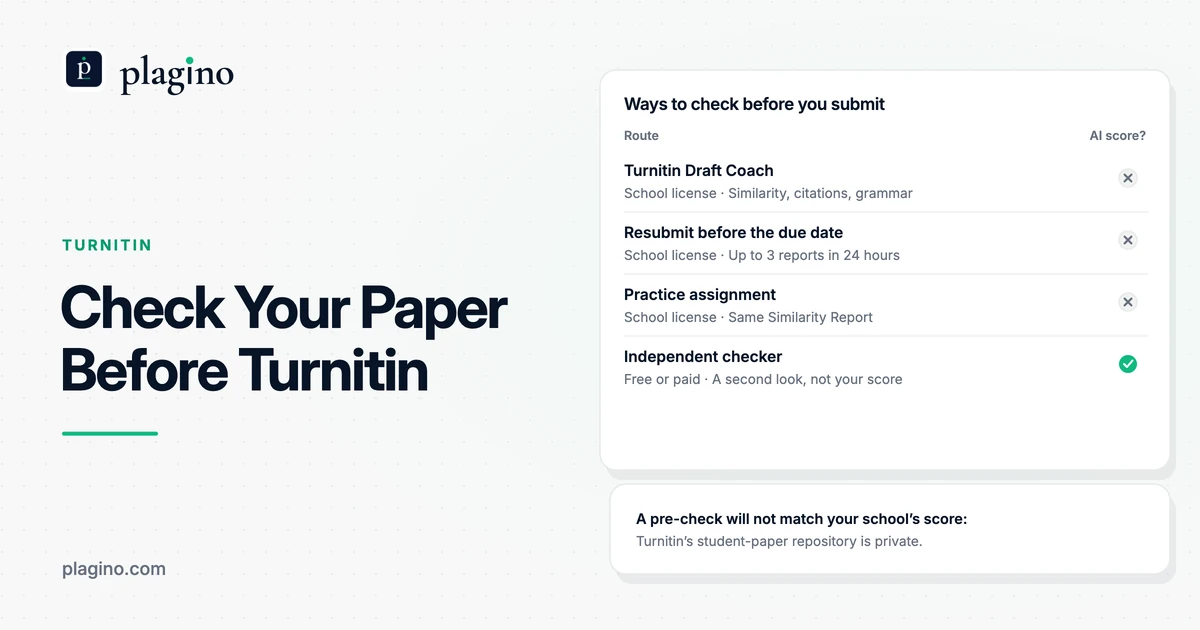
Like Turnitin, Plagino holds back low AI results: they show as 0%, borderline results show as an asterisk, and only clearer results appear as a number, with a count of flagged sentences. Its plagiarism check matches passages against open academic sources, not a school's private submission archive. To see both numbers on your draft before you submit, run it through the Plagino AI detector, or follow our guide to checking your paper before Turnitin.
- 1
Identify which number you are looking at. The percentage in the LMS inbox is similarity. The AI score lives inside the report on the AI Writing tab.
- 2
Check the AI indicator state. 0% means nothing was flagged. An asterisk means a result under 20% that Turnitin itself calls less reliable. Gray means the file was not processed.
- 3
Open the similarity matches. Separate quotations and references from uncited passages. Ask whether quotes and the bibliography were excluded.
- 4
Read the AI highlights in context. Look at where they cluster, and treat sentences at the edge of a flagged block with more caution.
- 5
Weigh the pair. Use the four-case table above to decide which highlights matter.
- 6
Bring process evidence. Outlines, notes, dated drafts and version history are stronger evidence than any single score. If you have been flagged, read what to do if you are falsely accused of using AI.
Teachers who want a fuller workflow can use our guide to AI detection for teachers.
Frequently asked questions
Can a paper have a low similarity score and a high AI score?
Yes. The two scores are calculated independently, and AI-generated text is usually new wording that does not match existing sources. So a paper can show a low similarity percentage and still have a high share of its prose flagged as AI-generated.
Does the AI score add to the similarity percentage?
No. Turnitin keeps the AI writing score separate from the similarity score, and neither changes the other. A 10% similarity and 30% AI result does not combine into 40% of anything.
What does it mean if the Turnitin report shows only one percentage?
It usually means you are looking at the similarity score. That is the number shown in the LMS inbox. The AI score appears only inside the report on the AI Writing tab, and only if your institution has AI detection turned on.
Is a 30% AI score bad on Turnitin?
It is above Turnitin's 20% reliability line, so the report will show the number and highlight the flagged sentences. Turnitin does not call any score bad, and says the result should not be the sole basis for action. What happens next depends on your institution's policy and on the highlights themselves.
Does the reference list count toward the Turnitin AI score?
No. The AI score covers only qualifying prose, meaning sentences in long-form writing. References, lists, headers, tables and code are left out of the calculation. They can still count toward the similarity score unless the instructor excludes the bibliography.
What does a gray AI indicator with no percentage mean?
It means Turnitin did not process the file for AI writing. Common reasons are a paper under 300 words of prose, an unsupported file type or language, or a submission made before the feature was enabled. Only the similarity score can be read in that case.
Is 0% AI and 0% similarity a good Turnitin result?
It means nothing matched the database and no qualifying prose was flagged. That is a clean result, but not proof of originality. Similarity checking can miss heavy paraphrasing, and Turnitin's AI model accepts missing some AI text to keep false positives low.
Who decides what Turnitin score is acceptable?
Your institution and your instructor decide. Turnitin publishes no acceptable similarity score and no acceptable AI score. Some universities and journals publish their own thresholds, so check your syllabus or academic integrity policy before relying on any range you read online.
Do academic journals use Turnitin AI score limits?
Some do. The IIUM Engineering Journal, for example, publishes AI score bands that treat up to 20% as low risk and more than 40% as grounds for desk rejection. Each journal sets its own policy, so check the author guidelines of the journal you are submitting to.
Why did my AI score change when I resubmitted the same paper?
Small edits can move sentences across the model's line, and short documents swing more because the prediction is close to all-or-nothing. Turnitin also updates its model from time to time. Compare the highlights between the two reports rather than the headline number.
Why does Plagino show 0% for low AI results?
Low scores are where false positives are most likely, so Plagino shows low AI results as 0% and borderline ones as an asterisk. Only clearer results appear as a number, with a count of flagged sentences. Turnitin uses a similar rule, drawing its line at 20%.