The short answer
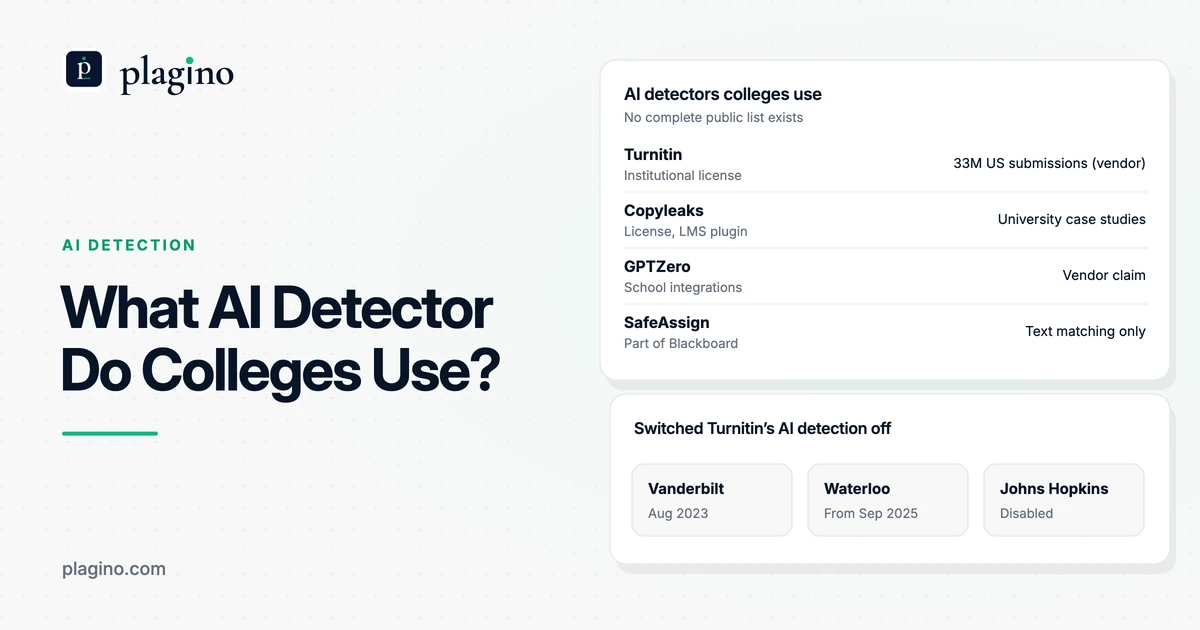
No single AI detector is used by every college. Turnitin is the best documented, Copyleaks and GPTZero report school customers, and several universities have switched AI detection off. No complete public list exists, so check your syllabus, your college's teaching-center pages, or ask your instructor.
What AI detector do colleges use?
There is no single AI detector that every college uses. Turnitin is the best documented. In July 2026 the company said it has more than 16,000 customers in 185 countries and territories, and that US higher education institutions sent 33 million submissions to its AI writing detection tools between October 2025 and April 2026. Those are vendor figures, and the customer count covers all of Turnitin's education customers, not only colleges.
Other colleges use Copyleaks or GPTZero, and a number have switched AI detection off. Copyleaks lists UNC Chapel Hill, the University of Cambridge and Miami Dade College among the customers on its academic integrity page, and GPTZero published a 2024 article about the University of Louisiana System adopting its detector. Both are vendor claims, so read them as examples of use and not as counts.
Why there is no public list of college AI detectors
We did not find any survey or agency that publishes which AI detector each college licenses. Each institution signs its own contract, and a college can license a tool without switching its AI features on. Both facts make a single national number hard to produce.
Some guides publish exact market shares anyway, such as a roughly 85% Turnitin share or 40% of four-year colleges using AI detectors. We could not trace either figure to a primary survey, so this page does not repeat them.
Which AI detectors do colleges use, and how do they get them?
Colleges buy a detector for the whole institution and often connect it to their learning platform. The table sets out what the public sources show for each tool, and who is making the claim. As of October 2026 none of this is an independent count.
| Tool | How a college gets it | Evidence of college use | Who says so |
|---|---|---|---|
| Turnitin | Institutional license. AI writing detection needs the Turnitin Originality license, or an add-on for iThenticate 2.0, and admins can switch it on or off. | 33 million US higher education submissions to its AI writing detection tools, October 2025 to April 2026. | Turnitin (vendor figure) |
| Copyleaks | Institutional license, often through a learning platform plugin such as Moodle. | Oakland University and Bucknell University case studies. The University of Illinois Springfield scheduled a pilot for April 2024 after citing Turnitin's rising cost and extra charge for AI detection. | Copyleaks case studies and a university notice |
| GPTZero | Institutional or learning platform integration sold to schools. | A 2024 article on the University of Louisiana System, and a listed Canvas integration. | GPTZero (vendor claim) |
| Blackboard SafeAssign | Part of Blackboard Learn. | Blackboard's documentation describes text matching against source material and does not describe an AI detector. | Blackboard documentation |
| No AI detector (switched off) | The college disables the feature. | Vanderbilt, the University of Waterloo and others, covered below. | University statements |
The Copyleaks and GPTZero rows come from the vendors' own pages, such as the Oakland University and Bucknell University case studies and GPTZero's integrations page, so each shows a customer story and not a market share. Our guides on Copyleaks and GPTZero compare them with Plagino using the benchmark data. For how the leading tool's score works, see whether Turnitin detects AI.
Do most colleges use Turnitin for AI detection?
Many colleges use Turnitin, but owning Turnitin is not the same as using its AI detector. Turnitin's FAQ says AI writing detection is only available to customers that license Turnitin Originality, and an institution that does not license it loses access across its accounts. A college can therefore run Turnitin for similarity checks and have no AI score at all.
Cost is part of the choice. The University of Illinois Springfield said in a March 2024 notice to faculty that it began looking at Copyleaks because of the rising cost of Turnitin and its decision to charge extra for AI detection. The University of Waterloo, which later turned the feature off, cited the expense of the tool in US dollars among its reasons.
Can a college switch Turnitin's AI detector off?
Yes. Turnitin's FAQ says admins can enable or disable the AI writing feature in their settings. Disabling it removes the AI writing indicator and report from the Similarity Report, so instructors and admins no longer see it until it is enabled again.
That was not true at launch. Vanderbilt wrote in 2023 that the feature was enabled for Turnitin customers with less than 24 hours of notice and, at the time, no option to disable it. The off switch exists now, which is why some colleges use it.
How can you tell which AI detector your college uses?
You cannot see it from the outside, so use the sources your college controls. Work down this list and stop when you get a clear answer.
- 1
Read the syllabus and assignment page. Instructors often state their AI and plagiarism policy there. Look for words such as Turnitin, similarity, originality or AI detection, and for rules on when AI tools are allowed.
- 2
Check the submission screen. Some checking tools show a terms-of-use prompt or a similarity setting before you submit. In Canvas, Instructure's developer documentation says a checking tool can ask students to accept its terms of use.
- 3
Search your college's IT or teaching center site. Many colleges publish guidance on AI detection. Vanderbilt, the University of Waterloo and the University of Illinois Springfield each published a public notice about the tool they use or stopped using.
- 4
Read the academic integrity policy. Look for how a detector score may be used and whether it can be the only evidence in a case. Policies differ between colleges and sometimes between departments.
- 5
Ask your instructor in writing. Ask which tool is used, whether AI detection is switched on for your course, and what happens after a flag. Turnitin's FAQ says the AI indicator is not visible to students, so you may never see the score unless your instructor shares it.
A written answer is useful if a flag is ever disputed. If one has already landed, read what to do if you are falsely accused of using AI. If you only want to know how your draft reads before you submit, Plagino's AI detector shows which sentences read as AI-generated, with a limit of 3 scans a month on the free plan.
Do teachers use Turnitin?
Teachers use Turnitin wherever their institution licenses it, but whether they see an AI score depends on the license and the college's settings. Turnitin's FAQ says the AI indicator sits inside the Similarity Report, reached through the learning platform, and that instructors can download the AI report as a PDF and share it with a student. Students do not see it by default.
Survey data shows how common detectors have become in schools, with a caveat. A Center for Democracy and Technology survey of 460 public school teachers in grades 6 to 12, run in December 2023 and reported by Education Week, found 68% had used an AI detection program. That survey covers K-12 teachers and does not say which tool they used, so it says little about college faculty.
College faculty are divided. Kevin Yee, who directs the Faculty Center for Teaching and Learning at the University of Central Florida, told Inside Higher Ed in August 2026 that if faculty had a reliable AI detector, that is what they would use, and that many are moving toward assignment redesign instead. Our page on Plagino for teachers covers how to weigh a detector's evidence.
Which colleges have turned off AI detection?
Several universities have publicly disabled Turnitin's AI detector or restricted how it is used. The table lists the cases with the strongest public sources, as of October 2026.
| Institution | What it did | Stated reason | Source |
|---|---|---|---|
| Vanderbilt University | Disabled Turnitin's AI detector on August 16, 2023 | No detailed information on how it works. At the 1% false positive rate Turnitin claimed, about 750 of the 75,000 papers Vanderbilt submitted in 2022 could have been wrongly labeled. Also bias against non-native English writers and privacy concerns. | Vanderbilt Brightspace team post (primary) |
| University of Waterloo | Discontinued Turnitin's AI detection from September 2025 | Research on unreliability and bias, cost in US dollars, and internal testing that flagged human-written text as 100% AI-generated more than once. | University of Waterloo notice (primary) |
| Johns Hopkins University | Disabled Turnitin's AI detection software, according to its teaching center | Reports of false positives and fear of falsely accusing students. The page adds that the university had no official policy on detection software at the time of writing. | Teaching @ JHU (primary, undated) |
| Northwestern, Georgetown and New York University | Reported among at least a dozen universities that disabled Turnitin's AI detection software | A false positive rate reported to be higher than the company first suggested. | Inside Higher Ed, August 5, 2026 (secondary) |
| Yale, Vanderbilt, Johns Hopkins and Indiana | Policies that ban or discourage relying on AI detection as the sole evidence of cheating | Inside Higher Ed reports concerns about inconsistent results, false positives and bias against non-native English writers. Indiana's Kelley School of Business playbook calls such tools highly unreliable. | Inside Higher Ed, August 5, 2026 (secondary) |
Turning the AI detector off does not remove plagiarism checking. Turnitin describes AI writing detection as a separate feature of the Similarity Report, so a college can keep matching text against sources while hiding the AI score." You can read the primary notices yourself: Vanderbilt, Waterloo and Johns Hopkins.
Why do some colleges stop using AI detectors?
The reasons repeat across the public notices. The first is scale: Vanderbilt did the arithmetic on Turnitin's own 1% claim and found it could mean about 750 wrongly labeled papers a year at one university. The second is fairness. A 2023 study by Liang and colleagues found that several widely used detectors consistently misclassified non-native English writing as AI-generated, and Vanderbilt cited the same concern.
The third is transparency and cost. Vanderbilt wrote that Turnitin gave no detailed account of how it decides, and both Waterloo and the University of Illinois Springfield named the price. The fourth is that tools which rewrite AI text can reduce what a detector finds. Yale's Poorvu Center told Inside Higher Ed it wants to avoid a technical arms race and keep the focus on learning.
Turnitin's own position is narrower. Its FAQ says the false positive rate for a document stays below 1%, that it does not make a determination of misconduct, and that the percentage should not be used as the sole basis for action. In July 2026 it also said it consolidated a multi-model ensemble into a single model while keeping that rate. In Plagino's test Turnitin wrongly flagged 1.4% of human documents, with a 95% interval of 0.7–2.9%, so a rate near 1% is within the margin of error.
What AI detector does Brightspace use, and how do learning platforms fit in?
Learning platforms usually host a third-party detector and do not run their own. Brightspace is an example: D2L's help page for Turnitin-enabled assignments describes the Similarity Report and Online Grading and does not mention an AI detector built into Brightspace. Vanderbilt's Brightspace team is where its 2023 decision to disable Turnitin's AI detector was posted.
The pattern holds on other platforms. Instructure's developer documentation describes plagiarism checks in Canvas using external tools, Blackboard's documentation says SafeAssign is built on a text-matching algorithm, and the Oakland University case study describes Copyleaks working through Moodle. Turnitin's FAQ adds that its AI score is not embedded in the platform's own screens, and users open the report to see it.
What plagiarism checker do colleges use?
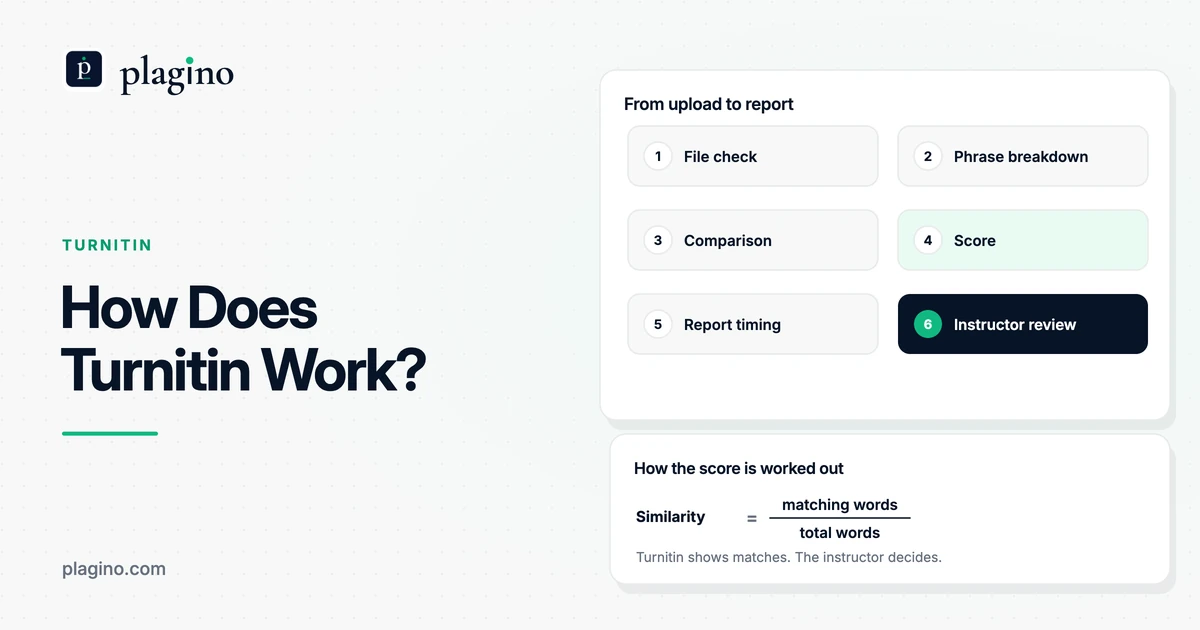
Turnitin's Similarity Report is the best-documented plagiarism checker in colleges, and SafeAssign and Copyleaks are other options. D2L's help page shows Turnitin colors a Similarity Report from blue (0 to under 20%) to red (80% and over), and SafeAssign reports the percentage of text that matches existing sources. A plagiarism checker looks for matching text. An AI detector looks for writing that reads like machine output, whether or not it matches anything.
Because the two checks answer different questions, a paper can pass one and fail the other. Our guides explain the Turnitin similarity score and compare the best plagiarism checkers for students. Plagino's own plagiarism checker matches against open-access academic literature only and does not search the open web.
How accurate are the AI detectors colleges use?
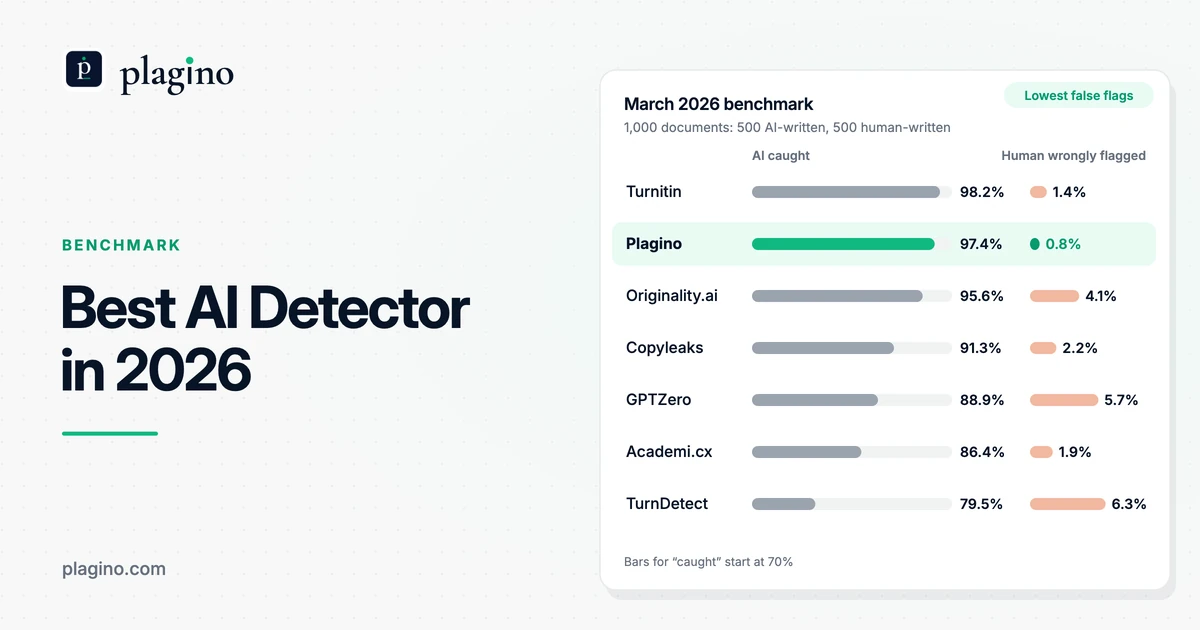
Plagino ran one head-to-head test, in March 2026, on 1,000 documents (500 AI-written (GPT-4o, Claude and Gemini, some lightly human-edited) and 500 human-written). It covers three tools named in this guide: Turnitin, Copyleaks and GPTZero. Turnitin caught 98.2% of AI documents, Copyleaks 91.3% and GPTZero 88.9%. Their false flag rates on human documents were 1.4%, 2.2% and 5.7%.
| Detector | AI documents caught | 95% interval | Human documents wrongly flagged | 95% interval |
|---|---|---|---|---|
| Turnitin | 98.2% | 96.6–99.1% | 1.4% | 0.7–2.9% |
| Plagino (this site) | 97.4% | 95.6–98.5% | 0.8% | 0.3–2.0% |
| Originality.ai | 95.6% | 93.4–97.1% | 4.1% | 2.7–6.2% |
| Copyleaks | 91.3% | 88.5–93.5% | 2.2% | 1.2–3.9% |
| GPTZero | 88.9% | 85.8–91.4% | 5.7% | 4.0–8.1% |
| Academi.cx | 86.4% | 83.1–89.1% | 1.9% | 1.0–3.5% |
| TurnDetect | 79.5% | 75.7–82.8% | 6.3% | 4.5–8.8% |
Read the table with its limits in mind. Plagino made the test and is one of the tools in it. The AI half of the corpus came from GPT-4o, Claude and Gemini, and every tool ran on default settings, which may differ from how your college has configured its own license. A Turnitin result here does not predict the score a college's Turnitin account would give. The full method is on the benchmark page, and our guide to the best AI detectors puts these numbers beside other tests.
If you want the numbers behind wrong flags, see why AI detectors produce false positives. If you are comparing options to the one your college uses, the guide to the best alternative to Turnitin sets out the choices.
What should students and teachers do about college AI detection?
Students should learn their college's policy first, keep evidence of their own writing process, and treat any detector as one input and not a verdict. Drafts, notes and version history show how a paper was written and help if a flag is disputed. If your course allows AI use with disclosure, disclose it.
Teachers should treat a score as a prompt to ask questions. Turnitin itself says the percentage should not be the sole basis for action, and several universities have written the same rule into policy. Compare the flagged passages with the student's earlier work, ask for drafts, and talk to the student before drawing a conclusion.
What are the limits of this guide?
This guide relies on public pages dated between 2023 and October 2026, and colleges change tools and settings often. A university notice from 2023 may describe a decision that has since been reversed, and a vendor customer page may be out of date. Confirm anything that affects you with your own college.
No source we found counts which detector each college uses, so the guide gives the best-documented examples and labels who made each claim. The only Plagino testing referenced is the March 2026 benchmark. Plagino has not benchmarked SafeAssign or any other tool not shown in the benchmark table, and it makes no accuracy claim about them.
Frequently asked questions
Do colleges actually use AI detectors?
Yes, many do, but not all. Turnitin reported 33 million US higher education submissions to its AI writing detection tools between October 2025 and April 2026, while colleges such as Vanderbilt and Waterloo have switched it off. There is no complete public count, so check your own college's policy.
Do all colleges use Turnitin?
No. Turnitin is the best-documented tool, but some colleges use Copyleaks or GPTZero, use SafeAssign for text matching, or have no AI detector. The University of Illinois Springfield, for example, scheduled a Copyleaks pilot in 2024 after citing Turnitin's cost. Plagino found no reliable share figure for any tool.
Can students see the AI score from Turnitin?
Not by default. Turnitin's FAQ says the AI writing indicator and report are not visible to students, although an instructor can download the report as a PDF and share it. Students may see a similarity score if the instructor allows it, but that is a different report.
Does Turnitin's AI detection cost extra?
It can. Turnitin's FAQ says AI writing detection is only available to customers that license Turnitin Originality, or the AI writing add-on for iThenticate 2.0. The University of Illinois Springfield said in 2024 that Turnitin charged extra for AI detection. Prices are set per contract, and Plagino has no public price list for it.
Do colleges use GPTZero?
Some do, according to GPTZero. It published a 2024 article describing the University of Louisiana System using its detector, and its integrations page lists a Canvas integration. Those are vendor claims, and Plagino found no independent count of GPTZero's college customers.
Do colleges use Copyleaks?
Some do. Copyleaks case studies describe Oakland University and Bucknell University using it through Moodle, and the University of Illinois Springfield scheduled a pilot for April 2024. These are vendor case studies and a university notice, not a market count.
Do community colleges use AI detectors?
Some do. Copyleaks lists Miami Dade College, the Maine Community College System and Bishop State Community College among its customers on its academic integrity page. That is a vendor claim, and Plagino found no independent list of community college tools.
Can a college punish a student based only on an AI detector score?
Turnitin itself says its AI percentage should not be the sole basis for action. Yale, Vanderbilt, Johns Hopkins and Indiana have policies that ban or discourage relying on detectors as the only evidence, according to Inside Higher Ed. What your college allows is set by its own policy, so read it.
What happens if my college turned the AI detector off?
Instructors stop seeing the AI indicator and report in Turnitin until an admin turns it back on. Turnitin describes AI writing detection as a separate feature of the Similarity Report, so text-matching reports are a different check. Instructors can still read your work and ask about your process.
Has Turnitin's AI detector changed recently?
Yes. Turnitin's FAQ says that in July 2026 it updated its model architecture, consolidating a multi-model ensemble into a single model, and that it still maintains a less than 1% false positive rate. That is Turnitin's claim. In Plagino's March 2026 test, which predates the change, Turnitin wrongly flagged 1.4% of human documents.
Can a college tell which AI tool a student used?
A detector estimates how much text is likely AI-written. It does not name the tool or prove who wrote it. Turnitin's FAQ lists the model families its detector is built to find, including GPT, Gemini and Claude models, and says it does not make a determination of misconduct.
Is Plagino the same detector my college uses?
No. Plagino is an independent tool and has no affiliation with Turnitin or any college. In its March 2026 benchmark it caught 97.4% of AI documents and wrongly flagged 0.8% of human ones, but its score does not predict the score a college's tool would give.
Which AI detector is closest to the one colleges use?
Plagino's March 2026 benchmark used Turnitin as the reference because it is the most widely documented college tool. Plagino scored 97.4% detection and 0.8% false flags against Turnitin's 98.2% and 1.4%, and those intervals overlap. Closeness in one test does not mean matching scores on your paper.