The short answer
An AI essay detector estimates which parts of an essay read like machine-written text. It scores sentence patterns, not authorship, so it cannot prove who wrote anything. Plagino marks the sentences that read as AI-written and matches open academic sources in a .docx upload. Treat the result as a reason to reread.
What is an AI essay detector, and what does it measure?
An AI essay detector is software that estimates how much of an essay reads like it was written by a language model such as ChatGPT. It does not look the essay up in a list of AI outputs. Scribbr explains that AI detectors measure characteristics of the text, such as sentence structure and length, word choice and predictability, rather than comparing it with a database of content.
Vendors describe their signals differently. Copyleaks lists frequency ratios, parts of speech, syllable dispersion and hyphen usage. The idea behind all of them is the same: a language model picks likely words, so its output tends to look more regular than a person's. The detector reports a percentage, highlighted sentences, or both.
That output is an estimate about patterns in the text. It is not an answer to who wrote the essay, and it cannot see how the essay was produced. Turnitin makes the same point about its own tool: its FAQ says it does not make a determination of misconduct and that the percentage should not be the sole basis for action.
How does Plagino work as an AI essay detector?
Plagino is our tool, so read this section with that in mind. You upload a .docx file of up to 10 MB and get back a PDF report with two separate signals: sentence-level highlights where the writing reads as AI-generated, and passages that match open-access academic papers. The report is meant for review. You read the highlighted sentences and decide what, if anything, to change. The AI detector page shows how it works and links a sample report.
The Free plan gives 3 scans a month with no card. Pro is $19 a month for 20 scans a day, with a priority queue and email support. Plans are on the pricing page. Files stay in your account so you can reopen a report, and you can delete any scan from your dashboard. The privacy policy says uploaded documents are not used to train AI models, so read it before you upload anyone's coursework.
Plagino is not Turnitin or any institution's tool, and its score will not match theirs. What it gives you is a way to see which sentences read as machine-like to one detector. Teachers who want a wider look at choosing a tool can read our page on the best AI detector for teachers.
Is there a free AI detector for essays?
Yes, several, but the free allowances differ in unit and size, and the unit matters for essays. The table lists what each vendor says about its own free access as of October 2026. Check the vendor's page before you rely on a figure, because limits change often.
| Tool | Free allowance, in the vendor's words | What it means for an essay |
|---|---|---|
| Scribbr | Unlimited checks, up to 1,200 words per submission, no sign-up | A 2,000-word essay has to be split, although Scribbr advises scanning longer text rather than single paragraphs |
| Copyleaks | Up to 25,000 characters per scan without logging in; a free account adds monthly credits and sentence-by-sentence insights | Counted in characters, not words, so compare units before you compare tools |
| GPTZero | A 10,000-character box on its homepage; scans over 10,000 characters need a free account | Long essays need an account; also counted in characters |
| Paperpal | 5 scans a day, up to 1,200 words each, in its own comparison table | Enough for most short essays, not for a long paper in one scan |
| Plagino | 3 scans a month on the Free plan, .docx files up to 10 MB, no card | Few scans, but a full-length file and a PDF report with highlights and source matches |
Free tools also differ in what they show. Copyleaks says on its AI detector page that sentence-by-sentence insights come with a free account, and Scribbr gives paragraph-level feedback. Paperpal and GPTZero list their own limits and plans. Whatever you use, read the privacy terms first, because an essay is someone's own work.
How reliably does an AI detector read different kinds of essays?
It depends on the essay. A detector reads prose, and it reads more reliably when it has more of it. The table collects what the vendors and one peer-reviewed study say about common essay situations, so you can see where a result deserves extra caution. It is a summary of those sources, not a Plagino test.
| Essay situation | What the sources say | Type of source |
|---|---|---|
| Very short essay or short answer | Turnitin does not process documents with under 300 words of qualifying prose. Scribbr advises scanning longer pieces, and GPTZero says accuracy improves with longer inputs | Vendor statements |
| Bibliography, data table, formula or code | Turnitin says it scores prose sentences in long-form writing and leaves out lists, headers, references, data tables, formulas and code | Turnitin FAQ |
| Light grammar fixes | Turnitin says that in its tests on human-written documents, changes from grammar tools such as Grammarly were mostly not flagged | Turnitin FAQ |
| Text from a generative feature (draft, paraphrase, summary) | Turnitin says content from these features will likely be flagged. Scribbr separates AI-generated from AI-refined text | Vendor statements |
| Mixed human-and-AI or heavily edited essay | Winston AI says detector performance dwindles on heavily revised human essays and on mixed writing | Vendor claim (a competing detector) |
| Personal narrative or reflective essay | Winston AI lists these among the text types where performance dwindles | Vendor claim (a competing detector) |
| Essay by a non-native English writer | Liang and colleagues ran 91 TOEFL essays through seven detectors, and on average the detectors misclassified 61.22% as AI-generated | Peer-reviewed study (2023) |
Two points follow. First, run the whole essay in one scan: Scribbr and Winston AI both note that short text gives a detector less context. Second, take extra care with second-language writing. The Liang study is a reason to treat a score as one input, and our explainer on why AI detectors produce false positives covers the cause.
How accurate are AI essay detectors?
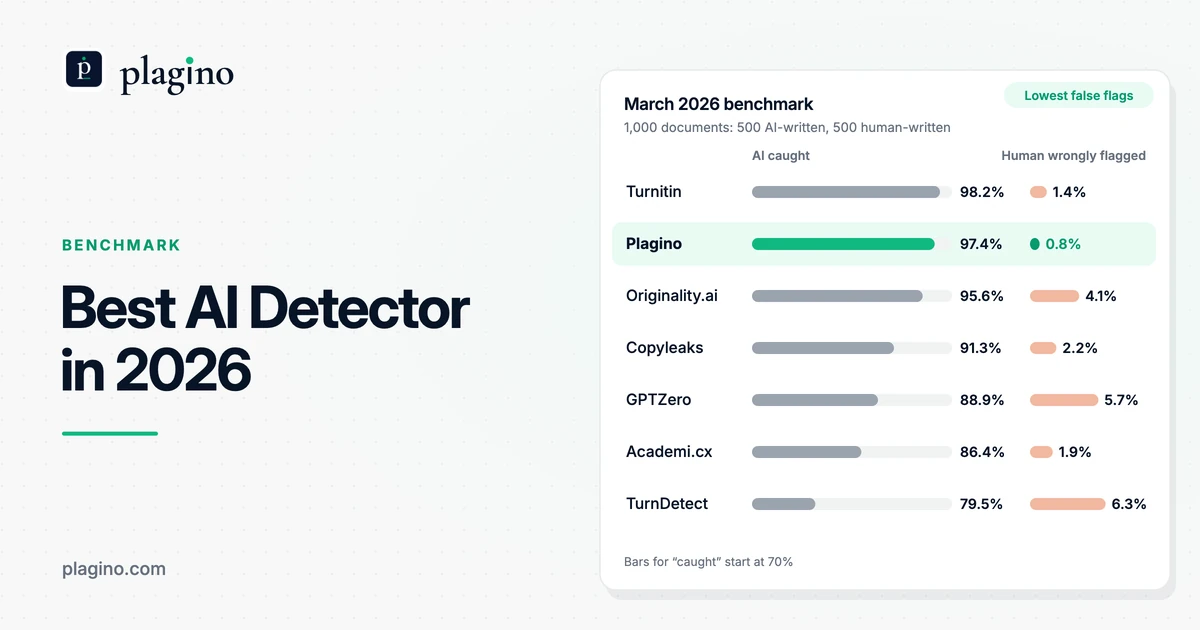
The only head-to-head data Plagino can stand behind is its own benchmark. The corpus had 1,000 documents: 500 AI-written (GPT-4o, Claude and Gemini, some lightly human-edited) and 500 human-written. Every tool saw the same files through its own web app on default settings, in March 2026. Scores are document-level: a document counts as flagged if the tool flags it at all.
| Detector | AI documents caught | 95% interval | Human documents wrongly flagged | 95% interval |
|---|---|---|---|---|
| Turnitin | 98.2% | 96.6–99.1% | 1.4% | 0.7–2.9% |
| Plagino | 97.4% | 95.6–98.5% | 0.8% | 0.3–2.0% |
| Originality.ai | 95.6% | 93.4–97.1% | 4.1% | 2.7–6.2% |
| Copyleaks | 91.3% | 88.5–93.5% | 2.2% | 1.2–3.9% |
| GPTZero | 88.9% | 85.8–91.4% | 5.7% | 4.0–8.1% |
| Academi.cx | 86.4% | 83.1–89.1% | 1.9% | 1.0–3.5% |
| TurnDetect | 79.5% | 75.7–82.8% | 6.3% | 4.5–8.8% |
In this run Turnitin caught the most AI writing (98.2%) and Plagino wrongly flagged the fewest human documents (0.8%). The intervals for those two false-positive rates overlap, so the gap is indicative, not decisive. Vendors publish higher figures of their own. Copyleaks, for example, claims over 99% accuracy on its page, and those are vendor claims that Plagino did not reproduce.
Detection rate is only half the picture for an essay checker. The other half is how many honest essays get flagged, and that depends on the mix of essays you scan.
How many flagged essays are actually AI-written?
It depends on how many essays in the stack are AI-written, and that is the number nobody knows. A detector with a low false-positive rate can still produce mostly wrong flags when AI essays are rare, because there are far more honest essays to get wrong. The table works this through using the benchmark rates for two assumed mixes.
Take 200 essays in which 10 are AI-written, an assumption of 1 in 20. At its benchmark rates Plagino would be expected to catch about 9.7 of the 10 and wrongly flag about 1.5 of the 190 honest ones, so about 87% of its flags would be right. A tool with GPTZero's benchmark false-positive rate (5.7%) would wrongly flag about 10.8 honest essays, and only about 45% of its flags would be right.
| Detector | Honest essays wrongly flagged per 200 honest essays | Flags that are right if 1 in 20 essays is AI | Flags that are right if 1 in 4 essays is AI |
|---|---|---|---|
| Turnitin | 2.8 | 79% | 96% |
| Plagino | 1.6 | 87% | 98% |
| Originality.ai | 8.2 | 55% | 89% |
| Copyleaks | 4.4 | 69% | 93% |
| GPTZero | 11.4 | 45% | 84% |
| Academi.cx | 3.8 | 71% | 94% |
| TurnDetect | 12.6 | 40% | 81% |
The lesson is practical. A flag is a prompt to read the essay and look at the drafts, not a finding. The more your essays come from students who rarely use AI, the more a single flag deserves doubt. Our guide for students who are falsely accused of using AI shows the other side of the same arithmetic.
What is the difference between an AI detector and a plagiarism checker for essays?
An AI detector estimates whether text reads like it was machine-generated, while a plagiarism checker looks for text that matches existing sources. They answer different questions, and an essay can fail one and pass the other. Winston AI makes the same split: an AI-written essay can pass a plagiarism check, and a human-written essay can still contain copied passages.
Plagino runs both signals on one upload, but its matching covers open-access academic literature indexed by CORE, not the open web or other students' papers. For a closer look at the matching side, see the plagiarism checker page. Grammar tools are a third category again. Grammarly's own AI detector page describes an Authorship feature that sorts text by where it came from, such as AI, an online database or typed by you.
How to check an essay for AI, step by step
This routine works for a student checking a draft and for a teacher reviewing a flag. It is built around evidence from the writing process, not around the score.
- 1
Read the AI policy for the assignment. Find what the course or school allows. Some courses allow brainstorming or grammar help, some allow nothing, and some ask you to disclose what you used. A detector cannot tell you what counts as misuse.
- 2
Scan the whole essay in one go. Upload the full .docx rather than single paragraphs, because short text gives a detector less to work with. Use the highlighted sentences, not only the overall percentage.
- 3
Run the plagiarism check separately. Treat matches and AI highlights as two different questions. Every quote and claim should be cited, and every source should exist and say what the essay says it does.
- 4
Read each flagged sentence. Ask whether it says something specific, in words the writer would use. Vague filler that could not be defended in discussion is worth rewriting in the writer's own reasoning. A flag is not an instruction to reword a sentence.
- 5
Compare with process evidence. Look at version history in Google Docs or Word, outlines, notes and earlier drafts, and compare the essay with the writer's earlier work. This is stronger evidence than any score.
- 6
Talk before deciding anything. Ask the writer to explain the argument and the sources. Keep a record of what was checked and what was said, and follow the school's own process for any concern.
Turnitin's FAQ says the same thing in different words: a percentage alone should not drive action. Students who need to prepare for a conversation can start from our guide on being falsely accused of using AI. Teachers can compare tools on the Plagino vs GPTZero and Plagino vs Copyleaks pages.
What are Plagino's limits as an AI essay detector?
We would rather you knew these before you sign up.
It is not Turnitin, and it does not see Turnitin's database
A clean Plagino result does not mean a school's own similarity or AI report will be clean. Plagino matches against CORE's open-access literature, so it will not catch copying from paywalled journals, the open web or other students' papers. Our comparison of Turnitin alternatives explains what outside tools can and cannot show.
Word files only, and no LMS link
Plagino takes .docx files up to 10 MB, one at a time, through its web app. It does not connect to learning platforms such as Canvas or Moodle, so the file has to be uploaded by hand. The Plagino site does not publish a minimum essay length, so treat very short pieces with the same caution as in the table above.
Its benchmark is its own
Our accuracy figures come from one benchmark that we designed and ran, on English essays, on default settings, in March 2026. An independent replication would carry more weight, and a 0.8% false-positive rate still means some honest writing is flagged. The benchmark was last run in March 2026, and its figures will age as the tools update.
Frequently asked questions
What is the best AI detector for essays?
There is no single best one, because it depends on whether you care most about catching AI writing or avoiding false flags. In Plagino's March 2026 benchmark, Turnitin caught the most AI writing (98.2%) and Plagino wrongly flagged the fewest human documents (0.8%). Plagino has not benchmarked tools such as Scribbr, Paperpal or Winston AI.
Is there a free AI essay detector?
Yes. Plagino's Free plan gives 3 scans a month with no card, and other vendors publish their own free limits, such as Scribbr's 1,200 words per submission. Limits change often, so check the vendor's page. A free tool's result does not predict what your school's tool will say.
How accurate are AI essay detectors?
No detector is fully accurate, and the figures depend on the test. In Plagino's March 2026 benchmark, the share of AI documents caught ran from 79.5% to 98.2% across seven tools. The share of human documents wrongly flagged ran from 0.8% to 6.3%.
Can an AI detector tell if ChatGPT wrote my essay?
It can estimate whether sentences read like ChatGPT-style text, but it cannot prove who wrote them. Detectors score patterns, so edited or mixed writing is harder, and honest writing can be flagged. Keep your drafts and notes as the real evidence.
Can an AI detector flag my own essay?
Yes. Every AI detector produces false positives, and in Plagino's March 2026 benchmark the rate for honest documents ran from 0.8% to 6.3%. Second-language writing carries extra risk. A 2023 study found seven detectors misclassified 61.22% of TOEFL essays on average.
How long does an essay need to be for an AI detector?
Longer is better, and some tools set a floor. Turnitin says it does not process documents with under 300 words of qualifying prose. Scribbr advises scanning longer pieces rather than single sentences or paragraphs. Plagino does not publish a minimum length.
Is an AI detector the same as a plagiarism checker?
No. An AI detector estimates whether text reads like machine writing, while a plagiarism checker finds text that matches existing sources. An essay can pass one and fail the other. Plagino reports both signals separately.
Can teachers prove a student used AI with a detector?
No. A detector score is an estimate, not proof, and Turnitin itself says its percentage should not be the sole basis for action. Drafts, version history, earlier work and a conversation with the student are stronger evidence. Follow your school's process.
Which AI detector do teachers use for essays?
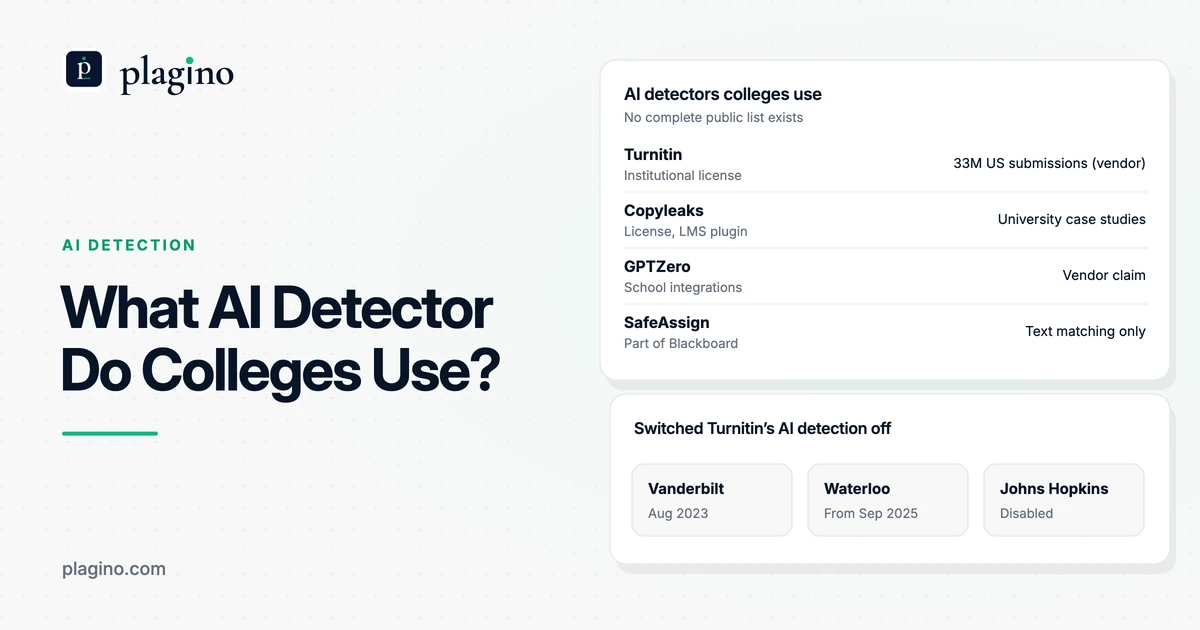
It varies by school, and there is no public master list. Turnitin's AI writing indicator is the best known and is sold with Turnitin Originality, and administrators can switch it off. Other schools use GPTZero, Copyleaks or other tools, or none.
What file types can I upload to Plagino?
Word documents (.docx) up to 10 MB, one at a time. Plagino does not connect to learning platforms such as Canvas or Moodle, so you upload the file yourself. Other formats are not supported.
Does Plagino keep my essay?
Files stay in your account while it is active so you can reopen reports, and you can delete any scan from your dashboard. Plagino's privacy policy says uploaded documents are not used to train AI models. To find plagiarism matches, only short extracts needed for matching are sent to CORE, an open-access research index.
What score counts as AI-written?
There is no universal threshold. Each tool defines its own score, and Turnitin, for example, hides scores from 1% to 19% and shows an asterisk. Use the highlighted sentences and the writing process, not a single cut-off.
Should I check a college application essay with an AI detector?
You can use one to find sentences worth rereading, but it cannot tell you what an admissions office will do. Colleges publish their own AI rules, and some adopt the Common App fraud policy. Read each college's AI policy page before you apply.